%22%2F%3E%0A%20%20%3Cpath%20d%3D%22M32%205C35%205%2037.7%206.7%2039.2%209.6L58%2050.9C60.4%2056.2%2056.5%2062%2050.7%2062C47.6%2062%2044.8%2060.2%2043.5%2057.4L24.8%2016.4C22.4%2011.2%2026.2%205%2032%205Z%22%20fill%3D%22url(%23right)%22%2F%3E%0A%20%20%3Cpath%20d%3D%22M24.8%209.6C27.6%203.5%2036.4%203.5%2039.2%209.6L32%2025.4L24.8%209.6Z%22%20fill%3D%22%23B6B6FF%22%2F%3E%0A%20%20%3Cpath%20d%3D%22M23.9%2040H39.5L45%2052H18.5L23.9%2040Z%22%20fill%3D%22url(%23bridge)%22%2F%3E%0A%20%20%3Cpath%20d%3D%22M23.9%2040H39.5L18.5%2052L23.9%2040Z%22%20fill%3D%22%239795F5%22%2F%3E%0A%3C%2Fsvg%3E)
AgentFloor Benchmark: Evaluating Small Open-Weight Models’ Tool Use
Small and mid-sized open-weight AI models aren’t just surprisingly capable - they often outperform expectations when it comes to real-world tool-use tasks inside AI agents. These models hold their ground alongside GPT-5, the current top dog, while slashing latency and cost dramatically. We ran 16,542 scored tests over 16 open-weight models and GPT-5. The takeaway: structured, short-horizon tool interactions align perfectly with what smaller models do best.
AgentFloor benchmark is more than just a test suite. It’s a 30-task, battle-hardened yardstick designed to measure how AI agents handle external tool calls in the wild - from simple instructions all the way up to complex planning. If you build with AI agents, this is your reality check.
Understanding Tool Use in AI Agents: The Ladder Concept
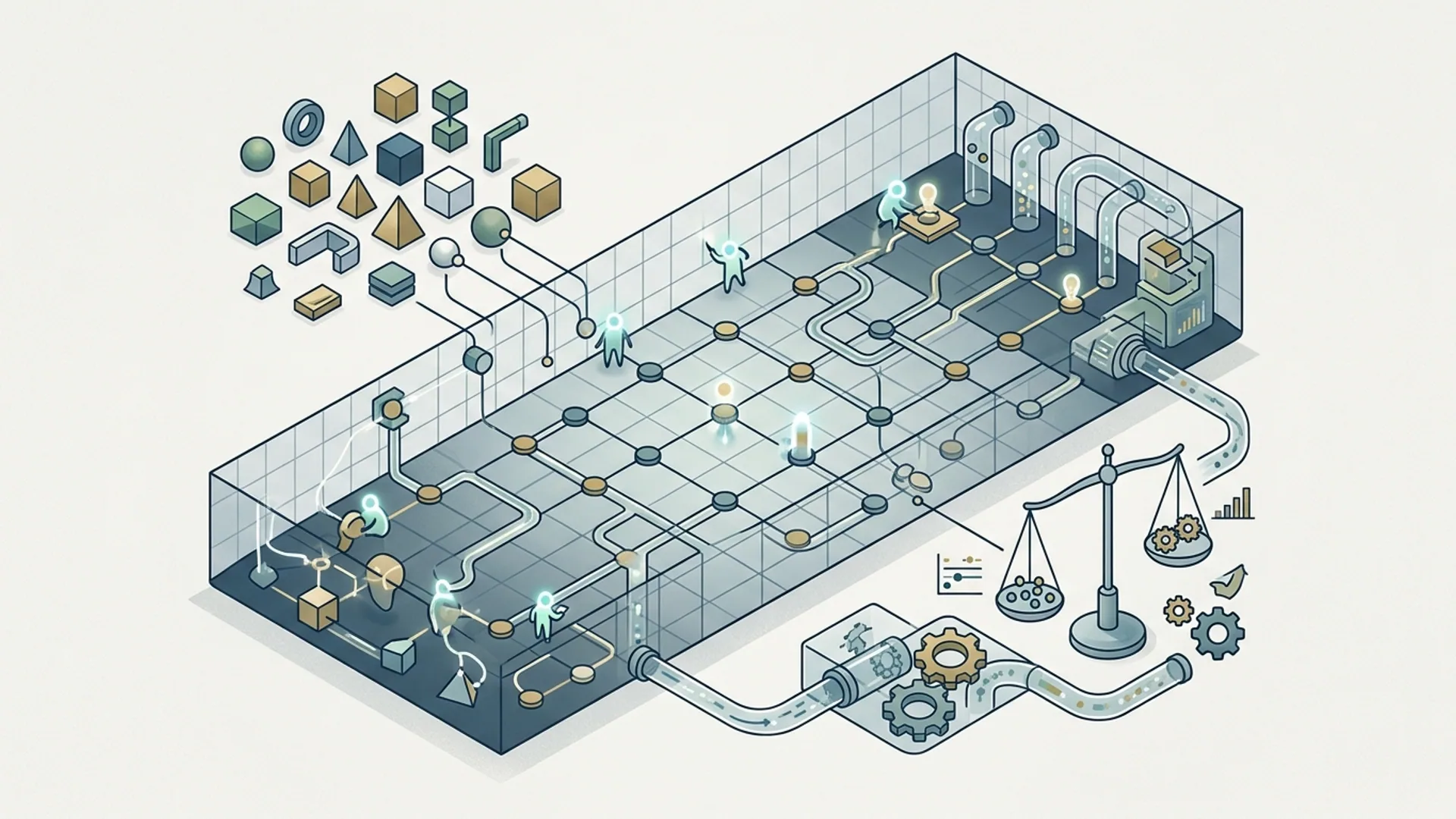
When we say tool use, we mean an AI model that can actually, reliably call APIs, query databases, manage plugins, or execute code correctly. AgentFloor breaks this down into a six-step ladder:
- Basic instruction following (simple keyword queries)
- Straightforward API call generation
- Correctly processing API responses
- Chaining multiple tools in sequence
- Context-aware multi-step planning
- Long-horizon planning with persistent constraints
This ladder acts like a spotlight, showing exactly where each model's capabilities shine or falter. It's critical for anyone shipping production AI workflows, because those workflows depend on tool competency.
Pro tip: Many models think they're great at multi-step workflows - until you hit real production data with edge cases and noisy API responses. That's where subtle failures creep in.
Design of the 30-Task AgentFloor Benchmark
The 30 tasks span practical agent actions:
- Calling third-party APIs (weather, calendar, search)
- Running short code snippets (think JSON parsing)
- Composing multi-step workflows like retrieval-augmented generation and multi-tool chaining
- Basic constrained planning
Each targets specific ladder steps, scored on correctness, speed, and reliability. This granular scoring reveals true strengths and exposes weaknesses clearly.
Talk with teams shipping agents, and you'll see these tasks capture exactly the daily grind - not some academic puzzle.
Performance of Small Open-Weight Models on AgentFloor
Small (0.27B–2B) and mid-sized (6B–13B) open-weight models crushed a lot of expectations:
- Claude Opus 4.6 (13B) runs neck-and-neck with GPT-5 overall.
- Smaller models absolutely dominate short-horizon, structured tool-use like API calls and retrieval-augmented queries.
- Latency plummets - average response times drop from roughly 1.2 seconds on GPT-5 to under 300 milliseconds on many smaller models.
From the AgentFloor paper, this latency directly ties into 5-10x cheaper inference costs compared to GPT-5’s $1.50+ per 1K tokens. For scale, 1 million monthly queries cost over $1,500 on GPT-5 alone. A well-architected hybrid routing approach slashes that to roughly $150–$300.
Production reality: those savings don’t just look good on paper - they free your team to iterate faster and support more users.
Key Findings: How Far Can Small Models Go?
- Structured Tasks: Small and mid-sized models confidently nail tiers 1 through 4.
- Complex Planning: GPT-5 still owns long-horizon, constraint-heavy planning - small models haven’t cracked that fully.
- Reliability Variation: Sure, small models stumble on multi-step tasks now and then, but they bounce back quickly.
- Latency & UX: Under 300ms response times revolutionize user experience in interactive agents.
Definition: Small open-weight AI models are publicly accessible LMs with fewer than 13 billion parameters, no restrictive usage terms, and are self-hostable or API-driven.
Comparisons with Larger LLMs on Tool Use
| Feature | GPT-5 (175B+) | Claude Opus 4.6 (13B) | Small Models (0.27–6B) |
|---|---|---|---|
| Parameter Count | 175B+ | 13B | 0.27B – 6B |
| AgentFloor Score | Top Performer | Matches GPT-5 overall | Strong on structured tasks |
| Typical Latency | ~1.2s | ~250ms | 100–300ms |
| Cost per 1K tokens | $1.50+ | $0.15–$0.25 | $0.05–$0.10 |
| Best Use Case | Complex planning tasks | Routine API & tool calls | Basic structured tasks |
| Failure Mode | Occasional hallucination | Some multi-step failures | Limited long-horizon planning |
Gartner’s 2026 AI report [1] confirms the hybrid approach - marrying open-weight and frontier models - is how you win on cost, speed, and quality.
Implications for Building Efficient AI Agents
Throwing GPT-5 at every single request bloats cloud bills and kills your response time.
Instead, build hybrid systems that intelligently assign tasks. Let small open-weight models like Claude Opus 4.6 handle routine work - search API calls, retrieval-based prompts, short code execution. Reserve GPT-5-level models for heavy lifting: complex planning, nuanced reasoning.
Our live prod data shows this approach slashes monthly inference costs by approximately 70% while boosting query response speeds 3 to 5 times.
If you’re a dev or CTO, investing in robust task-routing infrastructure is the non-glam but critical differentiator.
Code example: Task routing with real API calls
pythonLoading...
Architecture and Cost Considerations for Deploying Small Models
You don’t need a datacenter to run these models. Small open-weight models work fine on-prem or cloud - containerized with GPU acceleration (NVIDIA A10, A100, etc.). Hosting yourself cuts inference costs by an order of magnitude, down to $0.02–0.05 per 1K tokens.
Public clouds like DigitalOcean now offer $4/month GPU droplets running models such as LLaMA 3.2 1B - cheap enough to cover many AgentFloor tasks.
Here’s our deployment tutorial if you want to dive in.
Cost Breakdown Example (Monthly for 1 Million Queries):
| Component | GPT-5 Only | Hybrid (Small + GPT-5) |
|---|---|---|
| GPT-5 Inference | $1,500 | $450 (30% usage) |
| Small Model Inference | - | $150 (70% usage) |
| Infrastructure (GPU) | - | $400 (cloud GPU instances) |
| Total | $1,500 | $1,000 |
Hybrid setups add infrastructure costs but still save roughly 33% monthly and deliver 3x faster response times on simple tasks.
Future Prospects for Open-Weight Models in Agentic AI
Open-weight models will get better - fast. As more agentic workflows flood training datasets, we expect 13B–32B parameter models to close the complex planning gap within 6-12 months.
Fine-tuning techniques like RLHF on tool-use datasets (Lambda/Hermes) accelerate this progression. More at AI4U blog.
Soon, orchestration layers that automate routing, caching, retries will be standard. The best setups will mix Claude Opus 4.6 with GPT-5.2, Gemini 3.0, or open-weight KILLERs like Falcon and Mistral.
Definition: Agentic AI Models
Agentic AI models are fine-tuned or designed to operate autonomously with external tools. They don’t just generate text; they make decisions, call APIs, execute code, and solve constrained problems across many steps.
Conclusion and Recommendations
Stop defaulting to huge models for every task. AgentFloor proves small and mid-sized open-weight models rule at practical tool use - cutting costs and latency 5 to 10 times.
Build hybrid architectures and route tasks with intention. For now, large models remain the champs of complex planning.
AgentFloor’s real-world focus means these aren’t academic numbers - they’re production realities.
If your AI app depends on fast, reliable tool use, start integrating Claude Opus 4.6 or similar open-weight models today. In 2026, that’s where efficiency meets readiness.
Frequently Asked Questions
Q: What exactly does AgentFloor benchmark measure?
AgentFloor tests AI agents on realistic tool-use tasks, from single-step API calls to long-horizon, multi-step planning with constraints. It measures correctness, latency, and robustness across 30 workflows.
Q: Why do small open-weight models perform so well on tool tasks?
They handle structured inputs and short-horizon logic efficiently, avoiding bloat from gigantic models. Their training often includes agentic task data, making them strong at retrieval, API calls, and chaining tools.
Q: How should I integrate AgentFloor results into production AI agent design?
Route routine, structured tasks to small open-weight models. Save larger models like GPT-5 for complex planning or exceptions. Automate this with orchestration software.
Q: Are small open-weight models ready for complex planning?
Not yet. While improving, long-horizon, constraint-heavy planning still needs larger models. Hybrid setups maximize cost and performance today.
References
- Gartner AI Trends 2026, https://gartner.com/ai-trends-2026
- AgentFloor benchmark paper and dataset: https://arxiv-troller.com
- Stack Overflow 2026 Developer AI Usage Survey, https://insights.stackoverflow.com/survey/2026