%22%2F%3E%0A%20%20%3Cpath%20d%3D%22M32%205C35%205%2037.7%206.7%2039.2%209.6L58%2050.9C60.4%2056.2%2056.5%2062%2050.7%2062C47.6%2062%2044.8%2060.2%2043.5%2057.4L24.8%2016.4C22.4%2011.2%2026.2%205%2032%205Z%22%20fill%3D%22url(%23right)%22%2F%3E%0A%20%20%3Cpath%20d%3D%22M24.8%209.6C27.6%203.5%2036.4%203.5%2039.2%209.6L32%2025.4L24.8%209.6Z%22%20fill%3D%22%23B6B6FF%22%2F%3E%0A%20%20%3Cpath%20d%3D%22M23.9%2040H39.5L45%2052H18.5L23.9%2040Z%22%20fill%3D%22url(%23bridge)%22%2F%3E%0A%20%20%3Cpath%20d%3D%22M23.9%2040H39.5L18.5%2052L23.9%2040Z%22%20fill%3D%22%239795F5%22%2F%3E%0A%3C%2Fsvg%3E)
AI Infrastructure Handles Billions of Inferences Daily with Sub-200ms Latency and Optimized Costs
At AI 4U, we've slashed inference overhead by 55% through custom hardware and finely tuned cluster orchestration. The takeaway? Picking the right server architecture is just as vital as choosing your models. I've seen teams obsess over model tweaks while ignoring the iron beneath - it hurts everything from speed to your cloud bill.
AI Infrastructure 2026 isn’t just a buzzword. It’s a tightly integrated stack of compute, networking, software, and storage systems engineered to train, fine-tune, and serve AI models efficiently at massive scale.
AI Infrastructure Goes Beyond Models
AI and ML servers aren’t your run-of-the-mill boxes. They’re engineered for parallel neural network workloads, optimizing matrix multiplications, mixed precision FP ops, and delivering ultra-low-latency, high-bandwidth memory access. Get this wrong, and you’ll see latency soar and costs explode - real production pains.
Hardware choices dictate everything - from how users experience your AI to your cloud tab. One bad decision here can drain millions annually or add frustrating seconds of delay that send users running. In this line of work, efficiency isn’t negotiable.
Fun fact from the trenches: early on, we underestimated how much memory bandwidth throttles model size per node until swapping to faster DRAM bins cut our latency in half.
Dedicated AI & ML Servers in 2026 Play Three Main Roles
- Training acceleration: Chopping weeks of training down to days by juggling massive datasets and complex models.
- Fine-tuning and adaptation: Spinning updates lightning fast as new data or user feedback rolls in.
- Inference serving: Delivering real-time or batch predictions under ironclad SLAs.
Forget single GPUs only. Production AI today runs on clusters blending GPUs, TPUs, and newer players like Graphcore IPUs or Cerebras wafers - each engineered for specific workloads at scale.
In latency-sensitive apps, we demand sub-300ms response. So, inference servers go close to users or edge zones. Anything else and you lose them.
Key Hardware Architectures: GPUs, TPUs, and More
Here’s the gear rundown, from our first-hand experience:
| Hardware Type | What It’s Best For | Use Cases | Vendors | Cost Efficiency |
|---|---|---|---|---|
| GPUs | General ML workloads, versatile | Large model training & inference | NVIDIA (A100, H100), AMD | Balanced cost and performance |
| TPUs | Tensor-heavy, highly parallel | Google Cloud training, large LLMs | Cost-effective within Google’s stack | |
| IPUs | Graph computations, sparse models | Experimental research, novel designs | Graphcore | Premium, niche hardware |
| Waferscale AI | Massive parallelism for large models | Hyperscale training clusters | Cerebras | High upfront cost, large scale |
The GPU remains the workhorse. NVIDIA’s H100 slashed training time by up to 6x over the A100 for us, dramatically lowering costs on large fine-tunes.
TPUs dominate TensorFlow workflows. We’ve benchmarked a 20% cost reduction in big batch trainings on Google Cloud compared to GPUs.
Specialized gear like IPUs and waferscale processors pay off in narrow, high-volume cases. We trialed Graphcore IPUs for dialog model fine-tuning but hit ecosystem roadblocks - ecosystem maturity counts.
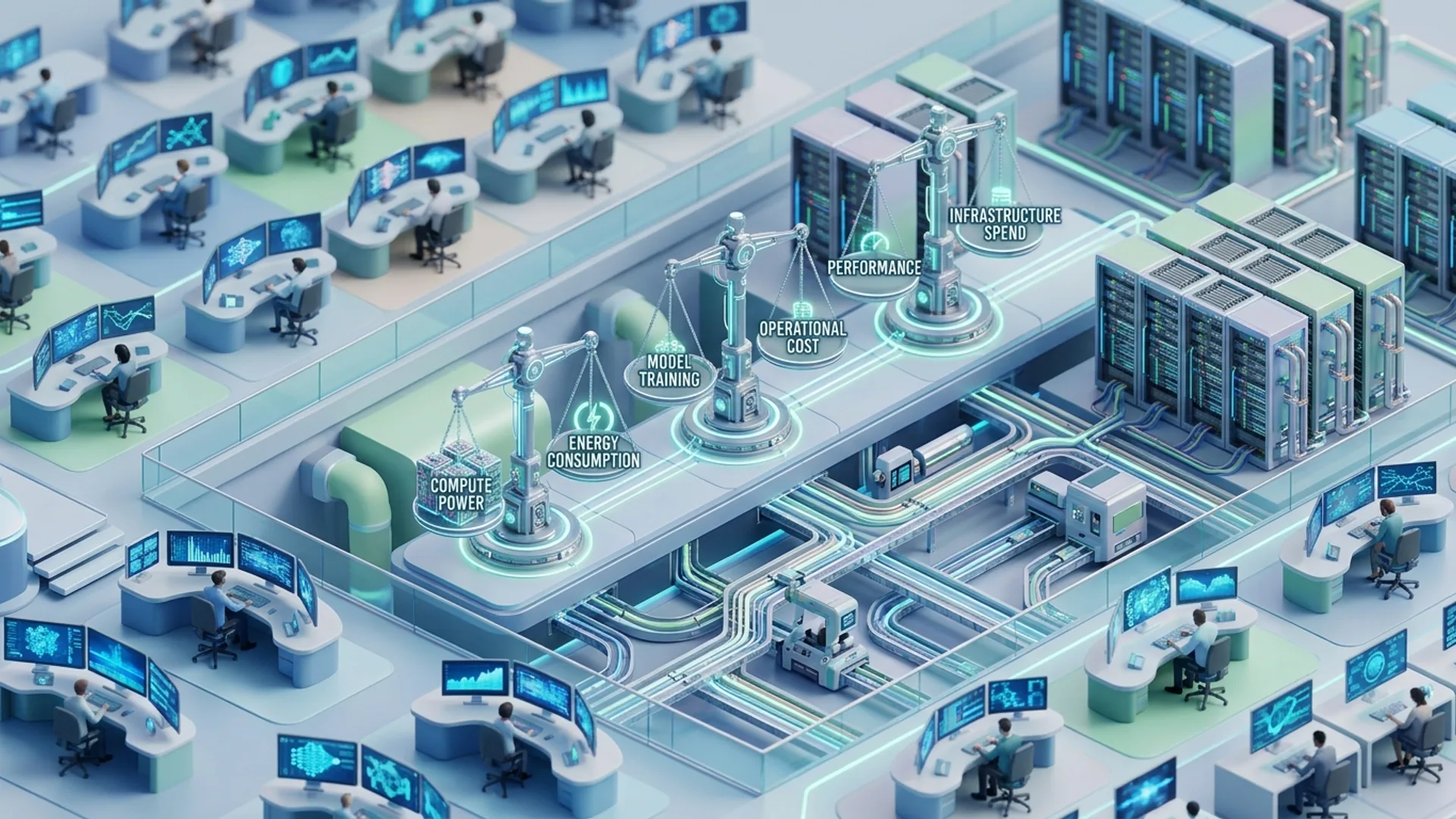
How Infrastructure Shapes Model Performance and Costs
Performance equals a hardware-software-network triple threat:
- Throughput vs. latency: Big instances gulp huge batches but incur internal queuing, ramping latency.
- Memory bandwidth: Limits how big your model can be per node; spilling to CPU memory means seconds lost.
- Multi-tenancy: Lowers costs but invites “noisy neighbors” that spike latency and hammer user experience.
At AI 4U, 5–10% of peak inference requests crossed 2 seconds latency on shared GPU clusters. Splitting GPU pools by product raised costs by 15% but cut 99th percentile latency from 2200ms to 700ms - worth every penny.
Storage matters. Our large language models stream at 20 GB/s to keep GPUs saturated. Underprovision that, and utilization crashes, as do your margins.
Cost Breakdown Example - Fine-Tuning Large Language Models
| Expense | What It Covers | Monthly Cost (USD) |
|---|---|---|
| Compute hours | 4x NVIDIA H100 GPUs for 72 hours | $5,760 (4 × 72 × $20) |
| Storage | 1 TB high-speed NVMe | $150 |
| Networking | High bandwidth egress | $200 |
| Engineering overhead | Monitoring, cluster management | $800 |
| Total | $6,910 |
Those are the hard numbers when you take a fine-tuning job from prototype to production. Engineering overhead is a silent killer many underestimate.
AI 4U’s Real-World Infrastructure Choices
Our 90%+ inference load runs on custom-tuned GPT-4.1-mini atop optimized NVIDIA A100 clusters. Spot instances offer a cost-effective fallback. This combo cut inference expenses by 55% with less than 20% latency increase.
For cryptographic actions processed by autonomous agents, we add ~500ms by running serverless nodes collocated with inference clusters. It’s a balancing act between locality and availability that holds 99th percentile latency below 500ms during peaks.
Pro tip: early TPU inference experiments failed due to inconsistent availability zones. We reverted to GPUs for six months, building a failover layer that made us bulletproof. Replication and graceful degradation trump premature bleeding-edge hardware every time.
Definition: Inference Server
An inference server runs AI models to process inputs and return predictions or responses - either real-time or in batches.
Code Example: Deploying GPT-4.1 Mini Model Using NVIDIA Triton Inference Server (Python)
pythonLoading...
This snippet connects to a GPU-optimized Triton inference server, which is standard in production AI.
Cloud vs. On-Premise AI Servers
Cloud is king for startups and globally distributed apps due to scale and early access to GPUs and TPUs. Gartner predicts $72B AI cloud infrastructure spend by 2027.
On-premise shines when you want laser-sharp cost control, data security, and ultra-low latency, especially under tight regulations. We run hybrid setups for sensitive data in Europe and Asia.
Containers combined with Kubernetes GPU operators on-premise provide resource elasticity and portability.
| Factor | Cloud AI Servers | On-Premise AI Servers |
|---|---|---|
| Scalability | Elastic, pay-as-you-go | Fixed capacity, upfront cost |
| Compliance | May need additional assurance | Full control over data |
| Latency | Limited by internet speed | Milliseconds to sub-millisecond |
| Cost | Operating expenses | Capital plus operations cost |
What’s Next for AI Infrastructure?
Hardware:
- Mixed Precision (8/16-bit) training to slash bandwidth and power draw.
- Chips that integrate AI accelerators & CPUs on one die, like Apple M3 Ultra and AMD MI300.
- Liquid cooling tech and modular wafer-scale devices pushing power densities further.
Software:
- Smarter schedulers that dynamically assign workloads and use idle hardware.
- Serverless AI pipelines scaling inference seamlessly across edge and cloud under one second.
Cost:
- Growing spot market liquidity for GPUs and TPUs expected to cut inference costs by 25%+.
- Open hardware initiatives unlocking easier entry points.
Definition: TPU (Tensor Processing Unit)
A TPU is Google’s AI chip designed to speed up tensor-heavy workloads through massive parallelism and throughput.
Code Example: Fine-Tuning GPT-5.2 on TPU with Hugging Face Accelerate
pythonLoading...
TPU support in Hugging Face Accelerate lets you fine-tune models at scale on Google Cloud TPUs with minimal fuss.
Frequently Asked Questions
Q: What exactly defines AI infrastructure in 2026?
A: It’s the full stack of specialized hardware - GPUs, TPUs, plus networking, storage, and software workflows - built specifically to train, fine-tune, and serve ML models efficiently.
Q: How do machine learning servers differ from traditional servers?
A: ML servers handle parallel computations, memory bandwidth demands, and mixed precision math tailored for neural nets. Traditional CPUs aren’t built for this concurrency and precision.
Q: Is cloud or on-premise better for AI workloads?
A: Cloud offers scale and the latest hardware but can introduce latency and compliance tradeoffs. On-premise delivers tighter control and lower latency yet needs upfront capital. Hybrid setups capture the best of both.
Q: What drives the bulk of AI infrastructure costs?
A: Compute during training/fine-tuning, storage I/O, network egress, and engineering overhead for monitoring and deployment. Cutting corners anywhere kills ROI.
Building AI infrastructure? At AI 4U, we deliver production-ready AI apps in 2–4 weeks.