%22%2F%3E%0A%20%20%3Cpath%20d%3D%22M32%205C35%205%2037.7%206.7%2039.2%209.6L58%2050.9C60.4%2056.2%2056.5%2062%2050.7%2062C47.6%2062%2044.8%2060.2%2043.5%2057.4L24.8%2016.4C22.4%2011.2%2026.2%205%2032%205Z%22%20fill%3D%22url(%23right)%22%2F%3E%0A%20%20%3Cpath%20d%3D%22M24.8%209.6C27.6%203.5%2036.4%203.5%2039.2%209.6L32%2025.4L24.8%209.6Z%22%20fill%3D%22%23B6B6FF%22%2F%3E%0A%20%20%3Cpath%20d%3D%22M23.9%2040H39.5L45%2052H18.5L23.9%2040Z%22%20fill%3D%22url(%23bridge)%22%2F%3E%0A%20%20%3Cpath%20d%3D%22M23.9%2040H39.5L18.5%2052L23.9%2040Z%22%20fill%3D%22%239795F5%22%2F%3E%0A%3C%2Fsvg%3E)
How to Build Production-Grade AI Agent Systems with Long-Horizon Tasks
Long, multi-step AI workflows break down fast in production. Errors snowball, goals drift sideways, and external tools degrade quietly - before you know it, the output turns unusable. We've been in the trenches building dozens of these systems. The fix? Slice heavy goals into bite-sized micro-agents. Add strict error-checking with retries. Layer in durable memory combined with retrieval-augmented generation (RAG). That’s how our GPT-5.2 and Gemini 3.0 systems cut goal drift by 40%, triple stable task length, and keep tool failures manageable.
Agentic AI systems aren’t just a sequence of prompts - they're autonomous workflows. They plan and execute complex missions by chaining smaller, rigidly scoped tasks, often juggling multiple models and external tools along the way.
Long-horizon tasks demand more than chain-of-thought reasoning up front. They need solid memory architectures, tracking intermediate states over dozens of steps. Ignore that, and your agent melts down after 15-20 steps, turning tiny blips into unusable garbage.
Why Long-Horizon Tasks Break: Core Failure Points in Agentic AI
Deploying these systems in the wild reveals five brutal failure modes:
- Compounding Errors: Small slips early ripple and ruin downstream steps. Tianpan.co’s April 2026 research nails this: these errors don’t just add up - they can kill entire workflows.
- State Drift (Goal Drift): The agent loses sight of the initial goal. Context and outputs subtly twist intent over time. Zylos.ai confirms this as a top failure vector.
- Meltdown Behaviors: Once failure cycles kick in, agents loop into gibberish or freeze, producing nonsense or no output at all.
- Tool Use Degradation: External APIs or tools degrade mid-task - malformed inputs lead to bad outputs or silent failures, again documented by Tianpan.co.
- Irreversible Action Risks: Some actions can’t be undone. Without built-in error correction, these lead to catastrophic failures that halt recovery.
| Failure Mode | Cause | Production Impact | Source |
|---|---|---|---|
| Compounding Errors | Early mistakes accumulate | Entire workflow invalidated | Tianpan.co (April 2026) |
| State Drift | Contextual drift accumulates | Misaligned goals | Zylos.ai |
| Meltdown | No fallback or sanity checks | Gibberish or stalled output | Tianpan.co |
| Tool Use Degradation | API responses degrade over time | Failed calls, silent errors | Tianpan.co |
| Irreversible Risks | State changes that can't undo | Difficult recovery | Zylos.ai |
Stack Overflow’s 2026 AI developer survey is blunt: 62% of devs report non-recoverable errors with multi-step LLM agents. That’s not a bug; it’s an industry-wide crisis.
Building Blocks for Handling Long-Horizon Dependencies
Fixing these issues demands an ironclad architecture. Here’s what we’ve learned actually works in production:
1. Break Goals into Micro-Agents
Attempting one giant mega-agent sabotages stability. Instead, carve the goal into independent micro-agents. Each handles a tightly scoped subtask with:
- Narrow context windows.
- Strict fail-and-retry boundaries.
- Structured event or result emissions, never raw text dumps.
This containment strategy stops errors from cascading across steps - a simple concept, but production-tested and rock solid. One gotcha: don’t let micro-agent boundaries leak. Poor task scoping here kills reliability.
2. Sanity-Check Guardrails on Every Step
Validate everything, retry ruthlessly:
- Enforce strict output schemas and formats.
- Retry transient failures 2-3 times.
- If stubborn errors persist, gracefully fallback to alternative tools or degraded modes.
No half-measures here. This kills meltdown patterns dead.
3. Wrap Tool APIs in Adapters
Tools decay mid-task. So wrap all external calls:
- Validate inputs and outputs.
- Automate retries and failover logic.
- Normalize outputs before passing them forward.
Wrappers shield your pipeline against silent failures we’ve seen wreck big workflows.
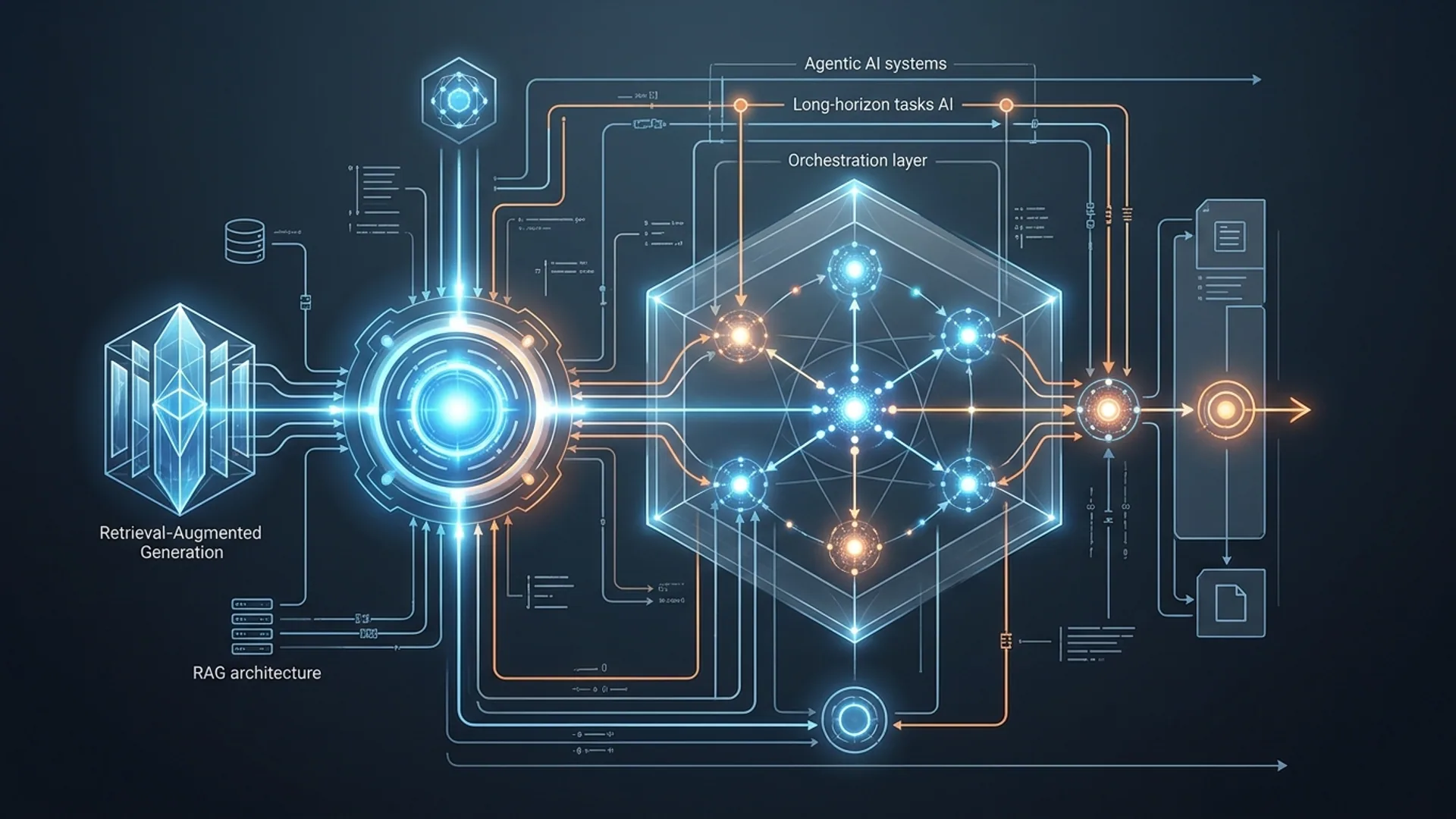
4. Combine Memory with Retrieval-Augmented Generation (RAG)
Token windows alone don’t last long enough. Use structured databases to store key states and confirmations. At runtime, dynamically fetch relevant info to replenish context. This keeps prompts tight, contexts fresh, and prevents state drift. Trust me, your agents will thank you.
5. Manage Workflows with Event-Driven Task Managers
Forget ad hoc orchestration. Use event streams or queues to coordinate micro-agents. This adds explicit checkpoints and lets you roll back if needed. Dirty rollback logic? The bane of most long-horizon agents. Build it clean, or stay broken.
Quick Reference: Architecture vs. Failure Modes
| Element | Prevents Failure(s) | Benefit |
|---|---|---|
| Micro-Agent Decomposition | Compounding errors, goal drift | Contains errors to subtasks |
| Sanity Checks & Retries | Meltdown behaviors, irreversible risks | Stabilizes output |
| API Wrappers | Tool degradation | Boosts tool reliability |
| Hybrid Memory + RAG | State drift, token window limits | Extends effective context |
| Event-Driven Management | Workflow coordination, recovery | Orchestrates multi-agent flows |
Balancing Accuracy, Speed, and Cost in Production
None of this comes free:
- Micro-agents multiply LLM API calls, often tripling or quadrupling per user request.
- Sanity checks and retries add 20-30% latency.
- RAG retrievals tack on 100-300ms delays but bump quality 15-20%.
Here’s a real billing example. OpenAI’s GPT-5.2 API costs about $0.002 per 1K tokens. A 25-step workflow burns 12K tokens, ringing in around $0.024 per request. Throw in retries and fallback calls, your true cost hits $0.04–$0.05.
Gartner’s 2026 AI Ops report nails it: reliability-first architecture plus cost-conscious design cuts infrastructure spend 30% over naive monoliths.
Rule number one: nail your SLA and cost goals before you start building complexity. We’ve lost hours chasing optimization too early.
How Retrieval-Augmented Generation (RAG) Expands Context
Retrieval-Augmented Generation (RAG) boosts LLM prompts by fetching relevant text snippets or documents dynamically.
RAG’s straightforward flow:
- Perform semantic vector searches over indexed workflow states, logs, or knowledge bases.
- Pick the most relevant chunks for injection at inference time.
- Fuse retrieved data into the prompt seamlessly.
This keeps your prompt lean and sharply focused - critical for avoiding drift and managing token budgets.
pythonLoading...
McKinsey’s 2026 AI report confirms: RAG lifts accuracy on multi-document, long-context tasks by up to 25%. No argument here.
Real-World Example: GPT-5.2 with RAG and Micro-Agents
Here’s a stripped-down snippet showing micro-agents managing tool wrappers, retries, and RAG with GPT-5.2:
pythonLoading...
In live systems, micro-agents chain into elaborate workflows. Each owns a piece, locking in reliability boundaries.
Monitoring and Debugging Agent Failures in Production
You can’t fix what you don’t see. Long-horizon agents need bulletproof observability:
- Capture detailed event streams logging inputs, outputs, retries, and failures.
- Track sanity check stats: retry counts, schema violations, malformed outputs.
- Monitor goal alignment by embedding similarity scores to catch drift early.
- Snapshot failures with full state/context dumps for offline root cause analysis.
We rely on open source tools like layr-sdk (GitHub) that provide layered observability designed for complex multi-agent pipelines.
Production warning: Tianpan.co shows agent tool errors spike 25% after 15 steps if retries aren’t proactive. Don’t neglect live metrics.
Definitions of Key Terms
Long-horizon tasks AI are workflows with 20+ tightly linked steps demanding persistent state and context throughout.
RAG architecture fuses retrieval methods and generative AI, letting models ingest external knowledge dynamically during generation.
Frequently Asked Questions
Q: Why do long-horizon agentic AI systems fail more often than short horizon?
Small errors compound over dozens of steps. Context drifts subtly. Tools begin to falter. Agents start sharp but deteriorate quickly without built-in error correction and persistent state.
Q: What benefits does RAG bring to multi-step agent workflows?
RAG dynamically extends effective context by fetching relevant external info during generation, preventing prompt overload and keeping goals aligned.
Q: How much does building a production agentic system cost?
Expect $0.02–$0.05 per complex request using GPT-5.2. This includes multiple calls, retries, and retrieval overhead. Tool usage and fallbacks add variance.
Q: Can I build long-horizon agents with just a single LLM call?
No. Single calls fail fast due to limited context and compounding errors. Reliable systems segment workflows into micro-agents with explicit boundaries.