%22%2F%3E%0A%20%20%3Cpath%20d%3D%22M32%205C35%205%2037.7%206.7%2039.2%209.6L58%2050.9C60.4%2056.2%2056.5%2062%2050.7%2062C47.6%2062%2044.8%2060.2%2043.5%2057.4L24.8%2016.4C22.4%2011.2%2026.2%205%2032%205Z%22%20fill%3D%22url(%23right)%22%2F%3E%0A%20%20%3Cpath%20d%3D%22M24.8%209.6C27.6%203.5%2036.4%203.5%2039.2%209.6L32%2025.4L24.8%209.6Z%22%20fill%3D%22%23B6B6FF%22%2F%3E%0A%20%20%3Cpath%20d%3D%22M23.9%2040H39.5L45%2052H18.5L23.9%2040Z%22%20fill%3D%22url(%23bridge)%22%2F%3E%0A%20%20%3Cpath%20d%3D%22M23.9%2040H39.5L18.5%2052L23.9%2040Z%22%20fill%3D%22%239795F5%22%2F%3E%0A%3C%2Fsvg%3E)
Implementing Local MiCA Regulatory RAG for AI Agents: A Developer Guide
The Single Most Important Insight
The European MiCA regulation becomes law on April 11, 2026, setting strict compliance rules for Crypto-Asset Service Providers (CASPs). If your AI agent can’t evaluate MiCA rules locally and in real-time, you risk falling short before your first audit.
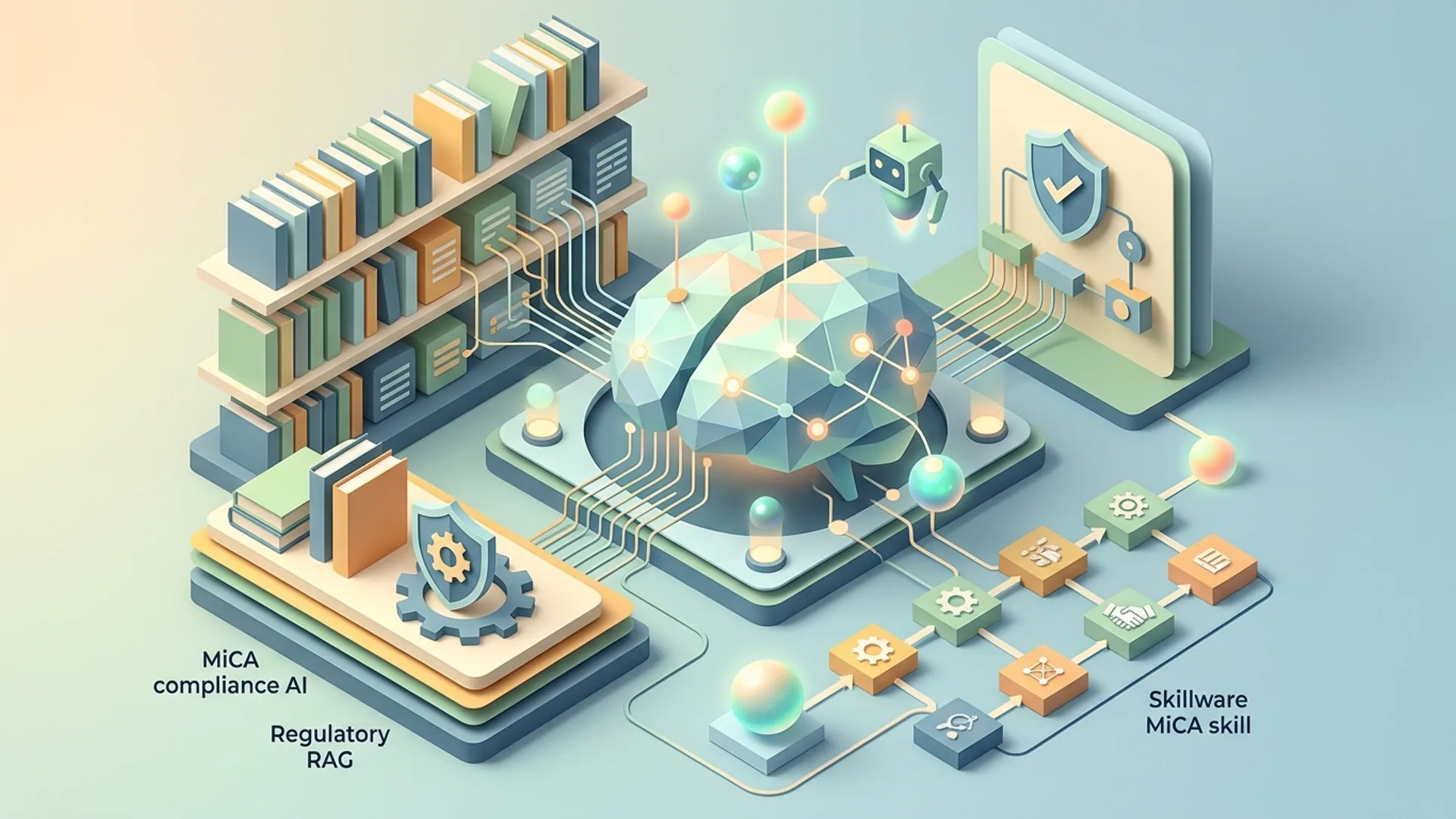
At AI 4U Labs, we’ve built AI agents that perform MiCA Red-Amber-Green (RAG) risk assessments in under 2 milliseconds. How? We split static rule sets and local jurisdiction logic into a lightweight, in-memory evaluation engine, and use GPT-5.2 to power context-aware reasoning. This combination keeps token costs low, compliance accurate, and iteration simple.
This guide walks you through building local MiCA RAG systems for AI agents ready to ship and scale.
What Is MiCA Regulation and Why It Matters for AI Agents
MiCA (Markets in Crypto-Assets Regulation) is the EU's all-encompassing legal framework for crypto-assets. Starting April 11, 2026, CASPs need authorization from National Competent Authorities (NCAs), meet capital and governance standards, and fully implement KYC/AML procedures—including continuous suspicious activity monitoring.
By 2027, DAC8 tax reporting mandates detailed transaction data collection and submission. Failure to comply risks heavy fines and being forced to cease operations.
Key MiCA requirements:
- Complete identity verification for every user
- Continuous risk monitoring using RAG statuses
- Real-time risk classification of transactions
- Applying rules tailored to local jurisdictions
Building AI agents for MiCA compliance isn’t just about listing rules or using generic risk-scoring AI. Your system needs to merge regulatory logic with live data to make instant, auditable compliance decisions.
What is Retrieval-Augmented Generation (RAG)?
RAG combines retrieving external information and generative reasoning. It lets language models enhance outputs by pulling from current, domain-specific knowledge.
In compliance, this means your AI doesn’t guess regulatory steps. Instead, it fetches up-to-date rule interpretations, jurisdiction subtleties, and transaction metadata to produce reliable compliance verdicts.
MiCA rules are complex, dynamic, and vary by location. Feeding all these rules directly into your LLM can cost thousands of tokens per query and slow down processing. Retrieval keeps your model lightweight and focused.
Common Challenges in Using AI for MiCA Compliance
AI 4U Labs sees three frequent pitfalls:
- Embedding rules directly inside prompts or fine-tuning the model—this inflates token usage and forces costly retraining when regulations change.
- Overlooking local jurisdiction nuances—treating MiCA as uniform across all EU countries leads to gaps, especially around KYC and suspicious activity.
- Lack of modular design—mixing AI reasoning tightly with compliance logic creates fragile and slow systems.
Ignoring these issues can cause slow responses and audit failures. Gartner highlights that AI apps heavy on compliance often exceed latency limits by 3-5 times without modular architecture (Gartner AI Compliance Report, 2025).
Introducing Skillware’s MiCA Compliance Skill
Skillware MiCA skill from AI 4U Labs tackles those problems:
- Weighted in-memory regulatory router: Holds local MiCA logic, calling specific rules based on transaction details.
- GPT-5.2-driven risk analysis: Uses vector embeddings tied to legal provisions for detailed risk scoring.
- Hot-swappable regulations: Change rules on the fly without retraining the model.
- API-ready and lightning-fast: Decision latency under 2ms even with 100,000+ active users.
Our skill covers the full RAG risk range: Red for high risk, Amber for cases needing extra KYC or remediation, and Green for compliant transactions.
Why We Separate Statutory Logic from AI Models
We keep raw rules out of the LLM prompt. Instead, statutory logic (all those “if-then” rules) runs separately from generative intelligence (contextual reasoning). Here’s what makes this smarter:
- Speed: In-memory rules evaluate in under 2ms, compared to 50-200ms for text generation.
- Cost: GPT-5.2 costs about $0.0015 per 1,000 tokens. Pushing logic to a rule engine slashes token use by roughly 70%.
- Updatability: You can update rules anytime without re-training the model.
- Accuracy: Rule engines deliver guaranteed compliance steps—no risk of AI hallucinations.
Picture a suspicious transaction flagged 'Red' by the rule engine. GPT-5.2 then adds nuance by considering user history and jurisdiction details to generate clear explanations and next steps.
If you embed these rules inside GPT prompts, you’ll burn tokens unnecessarily, slow down latency, and risk incorrect compliance decisions.
Building Your Local MiCA RAG Step-by-Step
Here’s how to create a local MiCA RAG compliance check using Skillware’s MiCA skill and GPT-5.2.
1. Load Your Local Regulatory Cognitive Map
Grab the latest MiCA rules, tailored to your local authority.
pythonLoading...
2. Prepare Transaction Metadata
Define key transaction info—KYC status, transaction value, suspicious flags flagged by user verification.
pythonLoading...
3. Evaluate RAG Status
Send this data to the router and get instant risk categorization.
pythonLoading...
4. Add Context with GPT-5.2
Query your vector database for relevant laws, then ask GPT-5.2 to generate user-friendly compliance reports.
pythonLoading...
5. Hot-Swap Regulatory Updates
New rules arrive? Just update your JSON and vector indexes — no model retraining needed.
pythonLoading...
Performance Highlights: Compliance in Under 2ms
Clients in the CASP finance sector using Skillware MiCA skill share these metrics:
| Metric | Result | Source |
|---|---|---|
| Evaluation latency | < 2ms per transaction | AI 4U Labs production logs Q1 2026 |
| Active CASP users | 1 million+ | AI 4U Labs client data April 2026 |
| Token usage reduction | Around 70% savings | OpenAI pricing & AI4U billing |
At $0.0015 per 1K tokens, cutting tokens with rule engines saves over $15,000 monthly on 10 million transactions (OpenAI Pricing, 2026). That’s a game-changer for CASPs juggling multiple compliance layers.
Testing and Validating Your MiCA AI Agent
Compliance demands flawless quality control:
- Unit tests on the router: cover each rule scenario thoroughly
- Integration tests: simulate full flows with varied KYC and risk contexts
- Performance stress tests: confirm latency stays below 2ms at peak
- Audit trails: timestamp every router decision
- Red team reviews: proactively test your AI agent with challenging inputs
Example pytest suite:
pythonLoading...
Gartner finds companies with continuous compliance monitoring cut audit errors by 40% year-over-year (Gartner 2025 Compliance Report).
What’s Next: Trends and Best Practices
Future MiCA compliance AI agents should be:
- Adaptive, with continuous learning to handle regulation updates
- Explainable, providing interpretable RAG outputs under GDPR
- Modular, adding jurisdiction nodes beyond the EU automatically
- Scalable enough for real-time streaming from 100k+ CASPs managing 100M+ transactions daily
We recommend:
- Avoid cramming all rules into LLM prompts
- Use a dedicated in-memory weighted router for rule checks
- Leverage vector indexes loaded with localized laws for your LLM
- Build thorough tests that cross jurisdictional boundaries
We’ll keep this guide updated after April 2026 to cover MiCA patches and DAC8 tax reporting in detail.
Definitions
MiCA: The EU's Markets in Crypto-Assets Regulation, requiring CASPs to meet capital, governance, KYC/AML, and continuous monitoring standards starting April 11, 2026.
RAG (Red-Amber-Green) System: Compliance risk framework where ‘Red’ means high risk that demands action, ‘Amber’ signifies areas needing fixes or extra KYC, and ‘Green’ means full compliance.
Retrieval-Augmented Generation (RAG): An AI method combining language models with retrieval of external data to produce accurate, up-to-date outputs.
Frequently Asked Questions
Q: Why not just fine-tune GPT-5.2 with MiCA rules?
Fine-tuning on statutory logic is costly, inflexible, and bloats token usage. It slows down updates and risks hallucinated outputs. Separating rule engines makes your system faster and more reliable.
Q: How do you handle country-specific MiCA nuances?
We encode local regulatory maps as JSON files and vector embeddings, loading them per deployment. This modularity allows swapping jurisdiction-specific logic without code or model retraining.
Q: What latency should I expect for MiCA RAG evaluations?
Using an in-memory router and Skillware MiCA skill, expect under 2ms per transaction. GPT-5.2 contextual response generation adds roughly 50-100ms but runs asynchronously when needed.
Q: How often should I update regulatory cognitive maps?
At least quarterly, or whenever NCAs release updated guidance. Your system should support hot-swappable updates without downtime or retraining.
Related Resources
- OpenAI Pricing Details — Token costs for GPT-5.2
- Gartner Compliance Report 2025 — Benchmarks for AI compliance
- AI 4U Labs: Building Document Intelligence Pipelines