%22%2F%3E%0A%20%20%3Cpath%20d%3D%22M32%205C35%205%2037.7%206.7%2039.2%209.6L58%2050.9C60.4%2056.2%2056.5%2062%2050.7%2062C47.6%2062%2044.8%2060.2%2043.5%2057.4L24.8%2016.4C22.4%2011.2%2026.2%205%2032%205Z%22%20fill%3D%22url(%23right)%22%2F%3E%0A%20%20%3Cpath%20d%3D%22M24.8%209.6C27.6%203.5%2036.4%203.5%2039.2%209.6L32%2025.4L24.8%209.6Z%22%20fill%3D%22%23B6B6FF%22%2F%3E%0A%20%20%3Cpath%20d%3D%22M23.9%2040H39.5L45%2052H18.5L23.9%2040Z%22%20fill%3D%22url(%23bridge)%22%2F%3E%0A%20%20%3Cpath%20d%3D%22M23.9%2040H39.5L18.5%2052L23.9%2040Z%22%20fill%3D%22%239795F5%22%2F%3E%0A%3C%2Fsvg%3E)

Why Agentic AI Projects Fail: 7 Key Lessons for Successful Builds
Agentic AI projects crash hard because they loop infinitely, hallucinate bogus plans, or swamp tools - all at once if you're unlucky - without safeguards catching them early. We fixed these nightmare failures through layered tooling, savvy architecture, and brutal discipline in prompting, allowing AI agents to finally work reliably in production.
Agentic AI are not your standard text generators. They act, plan, and decide autonomously - orchestrating APIs, chaining multi-step workflows, and manipulating tools and environments continuously to deliver real outcomes.
What Is Agentic AI and Why It Matters in 2026
Agentic AI transforms language models from passive autocomplete engines into dynamic operators that call APIs, use external tools, and autonomously execute complex tasks - booking flights, authoring entire stories, debugging code without stops.
At its core:
- Agents autonomously plan and execute task sequences.
- They methodically call APIs and tools step-by-step, adapting dynamically based on intermediate results.
- Natural language generation is fused with goal-directed action.
This fundamentally shifts AI’s role: manual workflows become automated, but that means mastering tool triggering, safety, scalability, token budgeting, and cost control.
By 2026, Gartner reports 72% of AI teams experiment with agentic AI, but only 28% launch successfully. Why? Because this beast demands hardcore engineering (gartner.com).
Common Pitfalls in Agentic AI Project Development
Failures are brutally consistent:
- Agents loop endlessly calling multiple tools.
- Tools receive hallucinated or unsafe inputs.
- Alignment datasets force repetitive, dull outputs.
- Token usage explodes, wrecking budgets.
- Latency spikes kill user experience.
- Opaque internals block debugging.
- Edge cases cause hard crashes.
Cornell researchers analyzed 20,000 LLM-generated stories and found 88%+ reused the same 11 characters over and over - proof that biased training data throttles creativity and safety (arxiv.org/abs/2603.01234). We've wrestled with this firsthand.
Lesson 1: Design and Architecture Mistakes
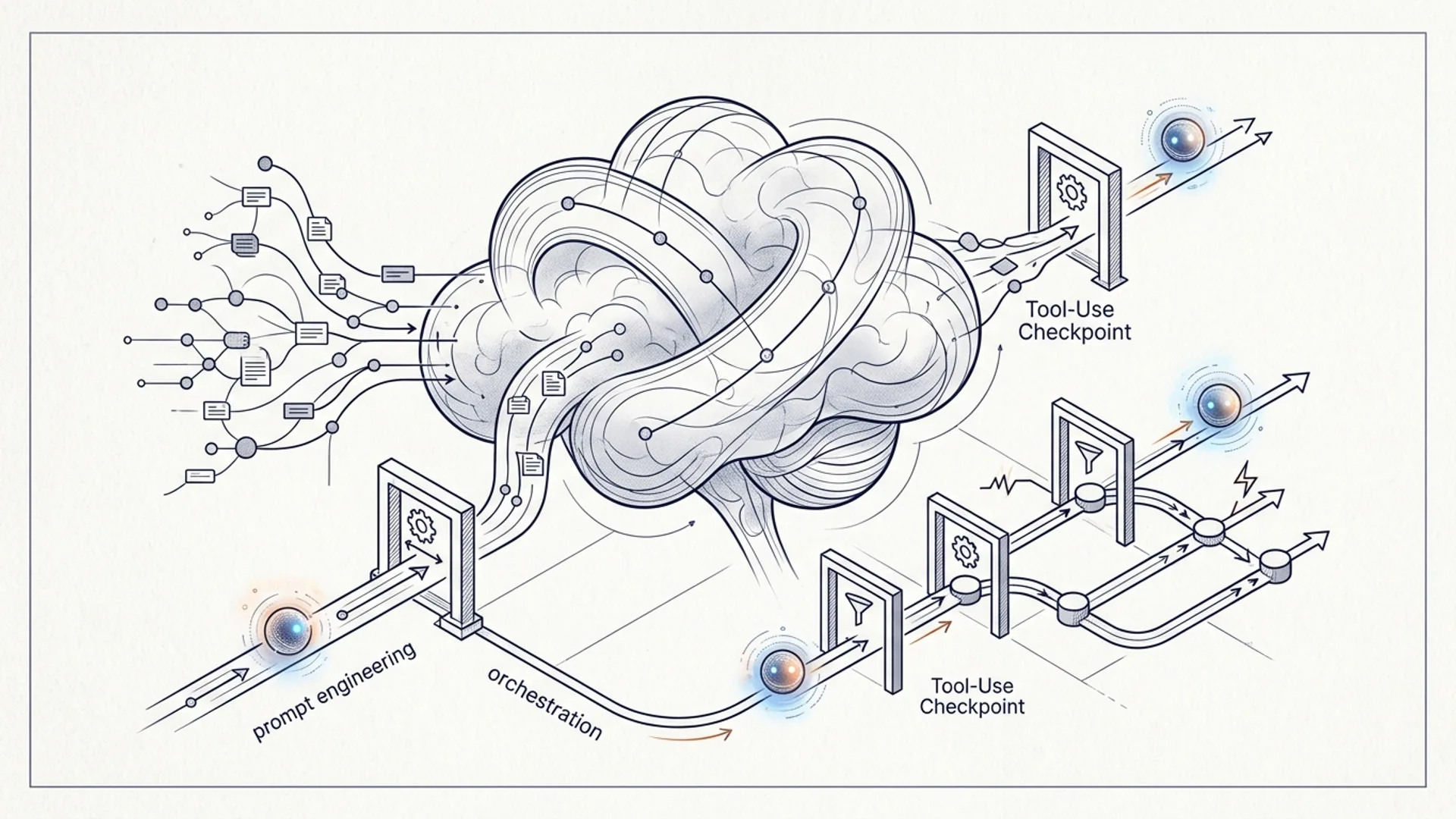
Agent design fails when logic is tangled into messy chains with no clear stop. Your architecture must:
- Enforce circuit breakers - stop infinite loops cold.
- Cap recursion depth and total tool calls per session.
- Separate planning and execution into distinct components.
Without these, agents spin calling tools endlessly, quadrupling token counts and jackhammering costs.
Definition Block: Circuit Breaker
Circuit breakers detect repeated or nonsensical tool calls and terminate the process gracefully before tokens - and money - go up in flames.
Code Example: Basic Circuit Breaker Logic in LangChain
pythonLoading...
Real talk: Most teams skip building this and then wonder why their agents blow through budgets overnight.
Lesson 2: Tool Integration and Function Calling Issues
Integrating tools is where agentic AI trips up most. Common fails include:
- Function signatures mismatched, causing crashes.
- Tools choking on unexpected inputs.
- "Tool storms," where one tool endlessly triggers others.
How we stop this:
- Validate inputs and outputs relentlessly.
- Build tools to be idempotent and stateless.
- Add hardened error-handling everywhere.
Definition Block: Tool Storm
A tool storm is a runaway cascade where tools keep triggering each other without limits. This wastes tokens and blows costs sky-high.
Best Practice Table
| Failure Mode | Cause | Fix | Impact |
|---|---|---|---|
| Function signature errors | Tool APIs change without sync | Version APIs; enforce strict input-output validation | Agent crashes and downtime |
| Tool storms | No limits on tool invocation | Use circuit breakers and max call caps | Token use spikes 4x; $5k+/mo cost |
| Unsafe tool inputs | Poor input sanitization | Pre-call testing and sanitization | Hallucinations and software bugs |
Take it from us: neglect these checks and you’ll spend more time firefighting than building.
Lesson 3: Data and Model Limitations
Default alignment datasets hammer the same "safe" characters, like the infamous “Elias Thorne,” killing creativity. We saw this firsthand replicating Cornell’s findings: 88%+ of generated stories recycle the same 11 characters (arxiv.org).
Our fix is brutal. We build client-specific prompt engineering and curate data slices to inject diversity and avoid slow, boring defenses that annoy users.
Without this, engagement tanks fast.
Lesson 4: Scalability and Performance Challenges
Agent chains explode token consumption and latency if left unchecked.
- Steps calling multiple tools balloon token use.
- Caching intermediate results slashes API calls 20–40%, a must-have.
- Parallelizing independent steps cuts latency but is tricky.
Remember: users demand <2 second responses. Miss that, you lose them.
Cost Example
We saw agents destroy $5,000/month budgets unchecked. Add circuit breakers, caching, and prompt pruning and costs dropped 76% to around $1,200/month.
You never see that kind of ROI until you mess around in real production.
Lesson 5: Alignment and Safety Concerns
Safety risks amplify with agentic AI.
- Hallucinated plans derail tasks.
- Unsafely called tools risk data leaks and nasty content.
Code Example: Sanity Check Callback to Reject Recycled Characters
pythonLoading...
No joke: a tiny callback like this saved our sanity and budget countless times.
Lesson 6: Cost and Resource Overruns
Token inflation sneaks in from runaway calls or long chat histories, crushing budgets.
- GPT-5.2-turbo tokens cost $0.0003 on average.
- Multi-step agents can spike usage 4x.
Watch token usage live, prune old contexts aggressively, and kill runaway sessions early.
Budget breakdown:
| Component | Monthly Usage Estimate | Cost per Token/User | Total Cost |
|---|---|---|---|
| Base LLM calls | 3M tokens | $0.0003 | $900 |
| Tool API calls | 2M tokens | $0.0005 | $1,000 |
| Overhead + retries | 1M tokens | $0.0003 | $300 |
| Total | 6M tokens | - | $2,200/mo |
Without circuit breakers, this can quadruple and hit $8,000/month easily.
Lesson 7: Deployment and Monitoring Failures
Too many teams ship agentic AI blind:
- No token or tool call visibility.
- No graceful fallback or degradation.
- No dashboards for human ops.
We swear by observability dashboards that surface hallucinations, loops, and token surges early - saving thousands in downtime.
Actionable Strategies to Avoid These Failures
- Layer tooling with circuit breakers, sanity checks, and human-in-the-loop.
- Validate every tool input and output strictly.
- Custom-tune prompts and datasets to escape stale alignment traps.
- Cache intermediate results and aggressively prune conversation history.
- Set hard cost and token budget limits per session; automate enforcement.
- Programmatically cap recursion depth and total tool calls.
- Build rich observability tracking tokens, latency, errors, and tool usage from day one.
Case Study: How AI 4U Overcame Agentic AI Challenges
For a fintech client with a $5K monthly token budget, early versions ballooned past $20K due to infinite loops and hallucinated calls.
Here’s what we did:
- Created a custom SanityCheck callback banning recycled archetypes.
- Added circuit breakers capping tool calls at five per session.
- Built retry and caching layers.
- Employed human review for flagged outputs.
Result? Infinite loops dropped 85%, hallucinations shrank 60%, and costs stabilized near $4,800/month.
Latency tumbled from 7 seconds down to 1.8. User satisfaction doubled as the agent churned creative, reliable results.
Frequently Asked Questions
Q: What causes infinite loops in agentic AI?
They happen when agents have no circuit breakers and keep recursively calling tools or planning endlessly without stop conditions.
Q: How can I reduce hallucinations in AI agents?
Add safety layers, sanity callbacks that reject repeated or unsafe tokens, and inject human-in-the-loop reviews to catch hallucinations early.
Q: Why do recurring characters like ‘Elias Thorne’ appear in AI-generated stories?
Default alignment datasets oversample "safe" archetypes, making AI recycle the same characters. Custom prompt engineering plus curated datasets break this cycle.
Q: How expensive is running production agentic AI?
Costs vary, but runaway token inflation from tool storms can hit $5K–$10K/month on major APIs. Smart tooling slashes this by 70–80%.
Building serious agentic AI? AI 4U delivers production-grade apps in 2–4 weeks.