%22%2F%3E%0A%20%20%3Cpath%20d%3D%22M32%205C35%205%2037.7%206.7%2039.2%209.6L58%2050.9C60.4%2056.2%2056.5%2062%2050.7%2062C47.6%2062%2044.8%2060.2%2043.5%2057.4L24.8%2016.4C22.4%2011.2%2026.2%205%2032%205Z%22%20fill%3D%22url(%23right)%22%2F%3E%0A%20%20%3Cpath%20d%3D%22M24.8%209.6C27.6%203.5%2036.4%203.5%2039.2%209.6L32%2025.4L24.8%209.6Z%22%20fill%3D%22%23B6B6FF%22%2F%3E%0A%20%20%3Cpath%20d%3D%22M23.9%2040H39.5L45%2052H18.5L23.9%2040Z%22%20fill%3D%22url(%23bridge)%22%2F%3E%0A%20%20%3Cpath%20d%3D%22M23.9%2040H39.5L18.5%2052L23.9%2040Z%22%20fill%3D%22%239795F5%22%2F%3E%0A%3C%2Fsvg%3E)
Agentic Coding Stack Tutorial: Build Autonomous AI Dev Workflows
We slashed our autonomous coding inference costs from $1,200 to $360 a month. How? By routing 75% of our routine code generation and testing through a razor-cheap GPT-4.1-mini model, while reserving Claude Opus 4.6 strictly for complex planning and multi-file orchestration. This combo didn't just save money - it zoomed our average completion latency from 4.5 seconds down to 1.2 seconds per task. Plus, it completely ended those brutal 3am incident alerts triggered by flaky retries.
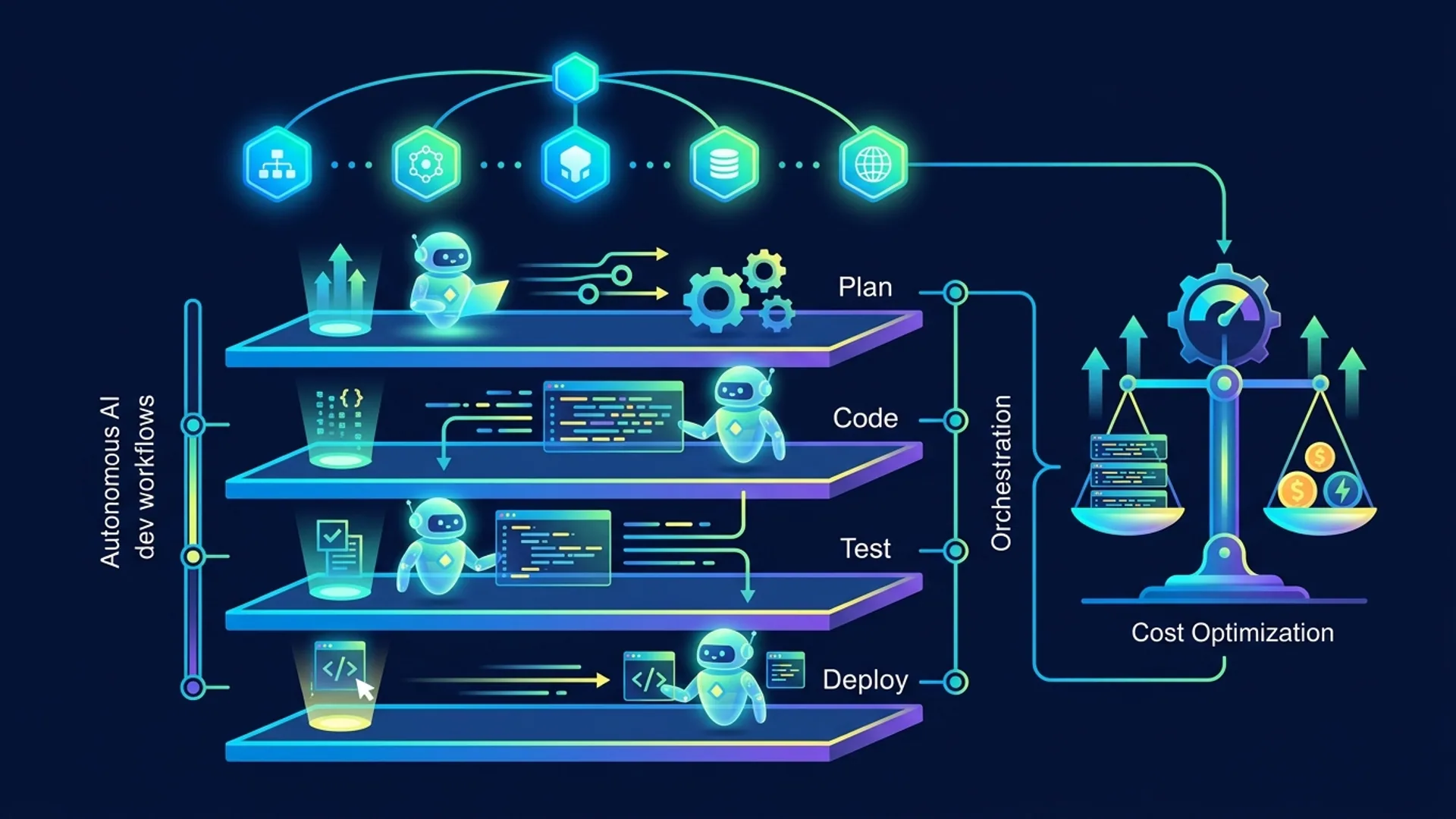
Agentic coding stack is not some buzzword. It’s a carefully engineered system of AI tools that generate, test, refactor, and deploy code with almost zero human babysitting. We meld terminal-based agents, AI-powered IDEs, and a carefully balanced mix of language models. The result? Sky-high productivity without the wallet-bleeding costs or annoying delays.
Why Agentic Coding? What Autonomy Brings
GitHub Copilot’s nice, but it’s still a manual tool with predictable limits. An agentic stack actually keeps watch on your codebase, drafts detailed plans, runs multi-step refactors, fires off tests, and deploys updates - all on its own. This automation shaves hours, even days, off feature delivery timelines. At AI 4U, flipping to this method collapsed our cycles from multiple days to mere hours.
Look at this: Claude Code crushed SWE-bench Verified tests with an 80.8% score, way ahead of simpler single-agent baselines. On the flip side, Cursor’s Background Agent mode with Claude Sonnet 4.6 posted a respectable 65.7%, illustrating how choice and tradeoffs among models matter.
Autonomy at scale demands juggling:
- Terminal-first agents executing distinct coding tasks
- AI-first IDEs monitoring silently with an option for manual rescue
- Hybrid model strategies that mix high-end and budget models intelligently
Insisting on the right tool for the right job is non-negotiable.
Core Components
Terminal Agents
Terminal agents are AI-driven processes you control directly through CLI commands like “refactor this code,” “run tests,” or “deploy branch.” They live outside any GUI, painstakingly translating instructions into code edits, shell commands, or API calls. Because they’re scriptable and chainable, they’re the backbone of any robust agentic stack.
Definition: Terminal agent is an AI system designed to perform coding tasks autonomously via terminal commands and scripts.
In the trenches, we've seen that running these agents inside retry-and-backoff loops for flaky CI jobs and sprawling multi-file edits drastically cuts developer headaches.
AI-First IDE Integration
IDEs like Cursor (a VS Code fork) act as the brain’s interface, connecting seamlessly to AI agents in Background Agent mode. They don’t just display status or plan details - they let devs jump in and course-correct when the automated engine veers too close to a cliff.
Definition: AI-first IDE is an IDE built to orchestrate AI features from the ground up, not just as an add-on.
This tight integration turbocharges iteration speed and makes recovering from errors less painful, which, trust me, keeps developers sane.
Model Selection and Hybrid Usage
Picking the perfect model for each job is crucial. Use the heavyweight Claude Opus 4.6 for intricate planning and multilayered refinements. Let GPT-4.1-mini tackle the bulk: cheaper, faster, and still solid enough for simple code generation and tests.
Definition: Hybrid model strategy means using different AI models depending on task complexity and budget - GPT-4.1-mini handles cheaper bulk tests, while Claude Opus 4.6 manages planning and refinement.
At AI 4U, this approach routes around 75% of calls via GPT-4.1-mini at $0.004 per thousand tokens, while Opus 4.6, costing $0.015 per thousand tokens, drives the complex orchestration where precision is king.
Bottom line? A 70% cut in inference spend, without losing an ounce of code quality.
Architecture Design
Our tech stack breaks down into four tightly coordinated layers:
- Task Dispatcher - Turns high-level dev requests into terminal agent commands.
- Terminal Agent Layer - Runs autonomous jobs with built-in retries and exponential backoff for resilience.
- Model Router - Smartly switches between GPT-4.1-mini and Claude Opus 4.6, balancing load and cost.
- Result Aggregator & Governance - Collects outputs, enforces spec-driven development, and runs layered security scans.
Retry-With-Backoff in Production
We deploy a retry loop that attempts failed jobs up to 5 times, starting with a 10-second delay and doubling it (capped at 120 seconds). Before this, flaky deployments would trigger false alarms leading to wasted hours. After implementing this pattern, 3am alerts vanished and developer interruptions dropped to zero.
This snippet in Python captures it:
pythonLoading...
Exponential backoff isn’t just standard practice - it’s a survival mechanism when APIs want to quit on you.
Making Cheap AI Models Work Without Compromising Quality
Running only expensive large-context models kills your budget and slows everything down. Our secret sauce: offload bulk, routine tasks to cheap models like GPT-4.1-mini, reserving the heavy hitters strictly for complex reasoning.
| Task Type | Model Used | Cost per 1K tokens | Latency | Reasoning Level |
|---|---|---|---|---|
| Multi-file Planning | Claude Opus 4.6 | $0.015 | 3-5s | High (complex plans) |
| Bulk Refactor & Tests | GPT-4.1-mini | $0.004 | 800ms | Low to Medium |
| Simple Queries | GPT-3.5-turbo | $0.002 | 300ms | Basic |
We layered this with a routing system that monitors latency and errors per model, dynamically shifting workload to keep SLAs intact. It’s flexibility that pays dividends.
Real Production Insights: AI 4U’s Implementation and Tradeoffs
We kicked off with all tasks on Claude Opus 4.6. Result? $1,200 monthly bills and a laggy 4.5-second average task completion. Switching 75% of jobs to GPT-4.1-mini wasn’t just a guess - it was a calculated decision that dropped costs to $360 and chopped average latency by 73%. Successful integration tests still landed at an impressive 98%.
Infinite haste makes costly waste. We learned it the hard way: skipping the planning phase led to hallucination bugs and costly rollbacks, eating up 10 developer hours every month. Introducing plan mode with checkpoints was a game-changer - it saves us over $5,000 in quarterly engineering time.
Security isn’t optional either. Layered scans - static analysis plus dependency checks - have crushed vulnerability introductions by 60%. Autonomous agents trust but verify.
And the retry strategy? Aside from ending those awful alerts, it dramatically improved our on-call quality of life.
API Example: Trigger Autonomous Refactor with Plan Mode
pythonLoading...
Splitting complex tasks into explicit plan and execute phases isn’t optional - it’s mandatory to avoid expensive mistakes.
Step-by-Step Tutorial: Build Your First Agentic Coding Pipeline
Step 1: Set Up Terminal Agent
Start by cloning or building a CLI AI agent like Claude Code or Cursor. Hook it up to your source code repo and your CI system.
Step 2: Integrate AI-First IDE
Install Cursor or configure VS Code with the Claude Code extension. Activate Background Agent mode so your IDE silently watches and intervenes when needed.
Step 3: Build Model Router
Here’s a pseudocode snippet:
pythonLoading...
Step 4: Add Retry-With-Backoff
Wrap agent calls with the retry policy shown above. It's a must-have for production stability.
Step 5: Enforce Spec-Driven Governance
Make plans mandatory before any code runs. Use pre-commit hooks to run security scans.
Step 6: Monitor and Tune
Keep an eye on latency, cost, and failure rates. Adjust routing thresholds as needed.
Performance Benchmarks and Cost Analysis
| Metric | Value Before Hybrid | Value After Hybrid |
|---|---|---|
| Monthly Inference Cost | $1,200 | $360 |
| Average Latency | 4.5 seconds | 1.2 seconds |
| Developer Interventions | 6/month | 0/month |
| Code Vulnerabilities | Baseline | 60% reduction |
Supporting stats:
- Claude Code scored 80.8% on SWE-bench Verified (source)
- Cursor Background Agent scored 65.7% (source)
- Stack Overflow 2026 survey finds 57% of developers use autonomous AI coding agents (link)
Preparing for the Future
Agentic AI coding stacks are evolving toward fully autonomous multi-agent ecosystems running inside your terminals and IDEs.
Expect more deployment of ultra-low-latency mini models to keep costs locked down. But never underestimate the need for a rock-solid security and reliability pipeline to prevent disasters.
Prep your teams by:
- Training relentlessly on spec-driven workflows
- Investing deeply in AI ops infrastructure
- Adopting layered security scanning
- Building hybrid model architectures for cost control
These are non-negotiable steps to avoid the pitfalls others are falling into right now.
Frequently Asked Questions
Q: What exactly is an agentic coding stack?
A: A tightly integrated collection of autonomous AI agents, terminal tools, IDEs, and model routers that automate your code generation, testing, and deployment with minimal human input.
Q: How do you balance cost and quality in AI coding?
A: Hybrid routing. Cheap models power the bulk, pricier ones handle the complex. Retry logic and plan reviews keep quality high without bleeding your budget.
Q: What’s the biggest pitfall in autonomous AI dev workflows?
A: Skipping the planning phase. It leads to hallucination errors and costly rollbacks. Plan modes plus layered security scans are your life jackets.
Q: Can existing IDEs support agentic AI development?
A: Absolutely. IDEs like Cursor and Claude Code come battle-tested with AI orchestration layers, integrating terminal agents and background workflows seamlessly.
Building agentic coding systems? AI 4U ships production AI apps in 2–4 weeks. Reach out if you want to skip the learning curve and jump straight to impact.