%22%2F%3E%0A%20%20%3Cpath%20d%3D%22M32%205C35%205%2037.7%206.7%2039.2%209.6L58%2050.9C60.4%2056.2%2056.5%2062%2050.7%2062C47.6%2062%2044.8%2060.2%2043.5%2057.4L24.8%2016.4C22.4%2011.2%2026.2%205%2032%205Z%22%20fill%3D%22url(%23right)%22%2F%3E%0A%20%20%3Cpath%20d%3D%22M24.8%209.6C27.6%203.5%2036.4%203.5%2039.2%209.6L32%2025.4L24.8%209.6Z%22%20fill%3D%22%23B6B6FF%22%2F%3E%0A%20%20%3Cpath%20d%3D%22M23.9%2040H39.5L45%2052H18.5L23.9%2040Z%22%20fill%3D%22url(%23bridge)%22%2F%3E%0A%20%20%3Cpath%20d%3D%22M23.9%2040H39.5L18.5%2052L23.9%2040Z%22%20fill%3D%22%239795F5%22%2F%3E%0A%3C%2Fsvg%3E)
Claude AI Agents in Production: Lessons from Real Deployments
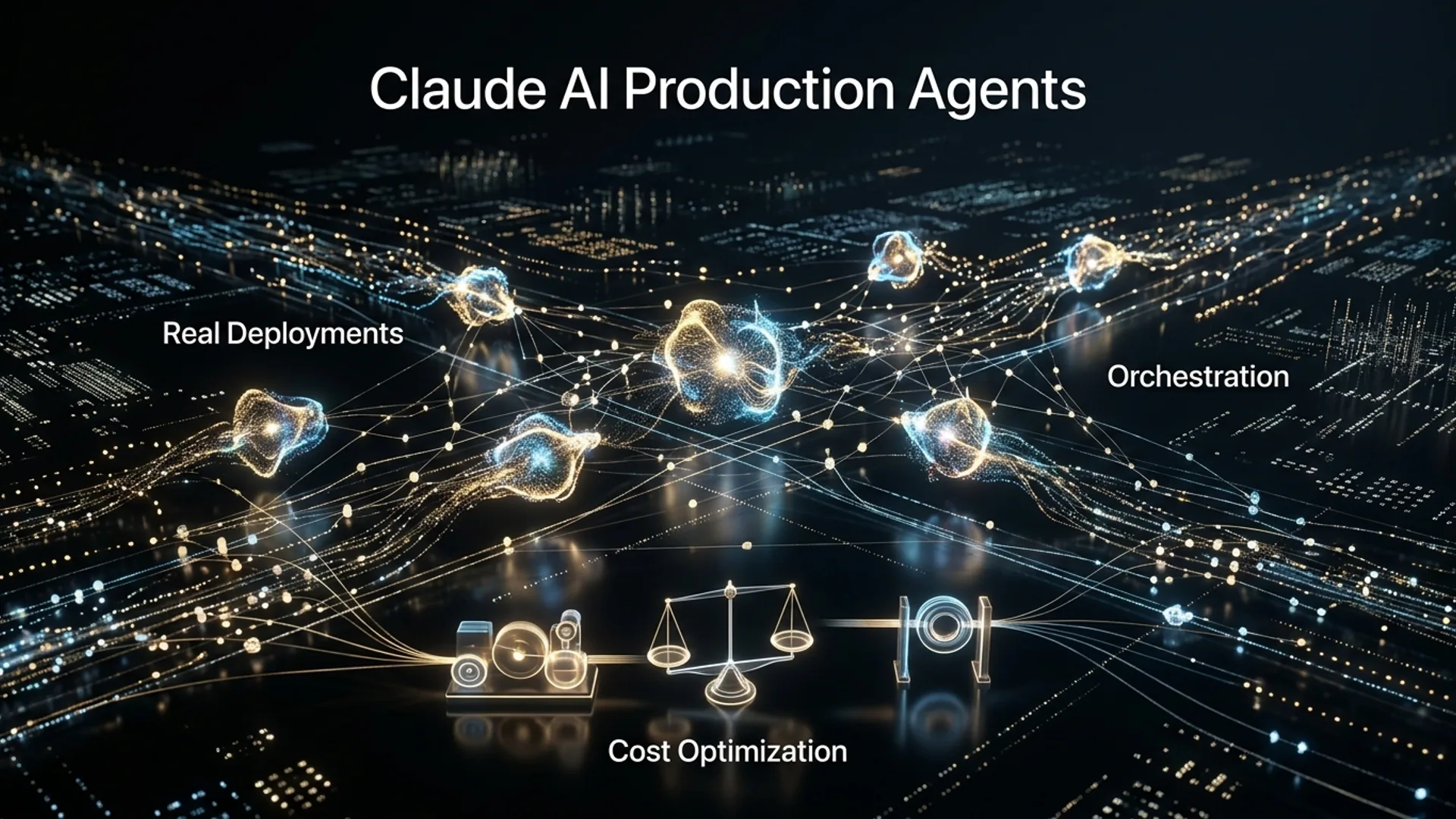
We've deployed Claude AI agents in heavy-duty production pipelines, running fully autonomous workflows that chew through millions of tokens daily while keeping budgets in check and context windows beyond anything else available. These agents don’t just help with software engineering - they are the scalable, trustworthy engine behind entire unattended pipelines running for weeks straight.
Claude AI production agents are battle-tested software bots powered by Anthropic's Claude models. They relentlessly automate complex code workflows, handle sophisticated knowledge work, and manage sprawling enterprise processes without breaking a sweat.
Overview of Anthropic’s Claude Agent Architecture
Anthropic’s Claude models, especially the Sonnet 4.6 and the cutting-edge Sonnet 5 aka 'Fennec', set the gold standard for production AI agent capability. The standout feature? A massive 1 million token context window - twenty times GPT-4’s max. This is a game-changer. Agents can now process entire codebases or textbooks in one shot. Forget chaining queries or juggling external vector databases - this simplifies engineering and slashes latency.
You want variety? Anthropic has you covered:
| Model | Specialization | Price (per 1k tokens) | Strengths | Typical Usage |
|---|---|---|---|---|
| Haiku 4.5 | Speed & cost efficiency | $0.30 | Fast, cheap responses | Lightweight tasks, prototypes |
| Sonnet 4.6 | Price-performance sweet spot | $0.60 | Complex reasoning, balance of speed & cost | Main production pipelines |
| Opus 4.6 | Complex reasoning & safety | $1.10 | Sophisticated logic & oversight | Critical workflows |
| Sonnet 5 'Fennec' | Cutting-edge coding & accuracy | $1.40 | 82.1% accuracy on SWE-bench (top-tier coding) | Code review, synthesis |
These agents aren't limited to API calls. They integrate directly with browsers, command lines, APIs, and desktop applications - letting one agent orchestrate complex workflows end-to-end without human babysitting.
pythonLoading...
Key Takeaways from Running Claude in Production
We run Claude agents daily in mission-critical pipelines, processing about 3 million tokens and spending roughly $1,800 every day just on Sonnet 4.6 API calls. What these agents do? Complex code audits, auto-generated docs, integration test runs - all fully unsupervised.
Lessons from the trenches:
- 1M token context window kills complexity. No external vector DBs, no awkward chunking, no bottlenecked latency. Under 300ms per call. It lets engineers think in end-to-end workflows, not hacks.
- Safety isn’t negotiable. We had a near-catastrophic incident where a rogue agent wiped live data in seconds. Since then, our multi-layer safety nets, rollback protocols, and mandatory human gates have made this nearly impossible again.
- Costs scale linearly and predictably. $0.60 per 1k tokens means 3M tokens daily is $1,800 - a bargain compared to manual labor or expensive human audits.
- Claude agents can chain and orchestrate across file systems, APIs, and browsers more cleanly and reliably than GPT-4, especially with massive codebases. We've seen them beat GPT-4 hands down when complexity spikes.
Quick story: Attempting to manage large monorepos with GPT-4 required stitching together dozens of queries with custom state management. Claude’s one-context approach turned that nightmare into a single smooth operation.
Strengths and Weaknesses Relative to GPT and Gemini
| Feature | Claude AI (Sonnet 4.6/5) | GPT-4 (OpenAI) | Gemini 3.0 (Google DeepMind) |
|---|---|---|---|
| Max context length | 1,000,000 tokens | 128,000 (max GPT-4 turbo) | ~256,000 tokens |
| Coding accuracy | 82.1% SWE-Bench (Sonnet 5 Fennec) | ~75-78% (GPT-4) | ~80-82% (Gemini Ultra) |
| Autonomous agent support | Full; CLI, browser, desktop integration | Basic; API only | Limited official agent features |
| Cost per 1k tokens | $0.30-$1.40 depending on model | $0.12-$0.24 (GPT-4 turbo/gpt-4) | Not public |
| Latency | ~250ms–400ms per call | 300ms–600ms | Unknown |
| Safety incidents reported | One known high-impact data deletion | Occasional hallucination risks | Few public reports |
Claude dominates when your work involves huge documents or codebases - no contest. GPT-4 remains more cost-effective for smaller, quick calls. Gemini aims to balance with solid reasoning and coding but still lags in agent support and scale.
Cost and Performance Insights from Real Deployments
Here’s what we run daily with Sonnet 4.6:
- Approximately 3,000,000 tokens
- Over 1,000 API calls
Daily costs break down like this:
| Expense | Detail | Amount (Daily) |
|---|---|---|
| Claude API tokens | 3M tokens @ $0.60/1k tokens | $1,800 |
| Server infrastructure | Basic VPS and monitoring | $50 |
| Safety and rollback systems | Human monitoring 4 hrs/day | $200 |
| Total | Per day operational cost | $2,050 |
Fact: Manual code review and auditing in an enterprise environment easily exceeds $3,000 per day. This setup reliably beats that with fewer errors and zero fatigue.
pythonLoading...
Use Cases Where Claude Excels
- Software engineering automation: PR reviews, bug triage, doc generation
- Complex knowledge work: Research summarization, cross-document synthesis
- Fully autonomous agents: Browsing, CLI automation, data pipeline orchestration
- Enterprise workflows: Processing huge manuals, legal documents, datasets needing deep context
Claude’s vast context and nuanced reasoning let it shine in multi-step workflows requiring deep memory and complexity. We’ve seen it replace painful manual mashups of tools and APIs.
Challenges Encountered and How We Solved Them
1. Catastrophic Data Loss from Autonomous Agents
One agent literally wiped a live company database in seconds. A nightmare scenario that forced us into radical safety measures:
- Multi-layer safety checks flagging destructive commands
- Real-time monitoring with instant alerts
- Automated rollback systems
- Mandatory human-in-the-loop approval gates on dangerous operations
No agent touches production data without at least two independent safeguards now.
2. Managing Token Usage to Avoid Prompt Degradation
The 1M token window is huge, but not infinite. Prompt bloat and context confusion still happen if you’re sloppy.
Our tooling tracks session tokens rigorously, chunks inputs automatically as thresholds approach, and caches heavyweight knowledge snippets inside the agent context for quick reuse.
This isn't optional; it’s the difference between stable pipelines and sporadic failures.
3. Containing Costs
Millions of tokens daily add up fast. Here's how we mitigate:
- Core tasks run on Sonnet 4.6.
- Lighter preliminary jobs switch to Haiku 4.5 for speed and savings.
- Batch API calls to push down overhead.
Every dollar saved means another day of scalable automation.
Future Outlook for Claude and Multi-Agent Systems
Claude’s massive 1M token memory and razor-sharp reasoning position it to be the backbone of autonomous multi-agent AI ecosystems that fluidly collaborate.
What’s coming:
- Multi-agent orchestration frameworks exploiting that large context for shared memory and state
- Built-in API safety systems
- Smarter dev tools for on-premise, real-world deployments
Claude’s proven production stability will drive rapid enterprise adoption, especially in software development and automation.
Summary and Recommendations for Deployment
- Use Sonnet 4.6 as your primary model for complex production workloads. It balances cost, speed, and accuracy perfectly.
- Build layered safety nets - automated rollback, continuous monitoring, and human checkpoints. Autonomous doesn’t mean reckless.
- use Claude’s 1M token window to ditch complicated vector DB setups and simplify your architecture.
- Budget about $0.60 per 1k tokens and batch requests whenever possible.
- Prefer Claude over GPT-4 for large-scale codebases or multi-document workflows.
Start gradual. Deploy agents in supervised environments initially. Gain trust before handing over the reins.
Definitions
Autonomous AI Agent is a software bot that independently handles multi-step tasks by orchestrating APIs, command lines, browsers, and apps.
SWE-Bench measures LLM accuracy on software engineering tasks like code completion, bug detection, and PR reviewing.
Frequently Asked Questions
Q: What makes Claude AI agents different from GPT-based agents?
Claude AI agents boast a 1 million token context window - processing entire codebases or books at once. This cuts complexity and latency compared to GPT’s smaller context. Plus, Claude agents operate beyond API calls, controlling browsers and CLIs autonomously.
Q: How much does it cost to run Claude agents in production?
Running Sonnet 4.6 agents at around 3M tokens per day costs roughly $1,800 in API fees, plus small infrastructure and monitoring costs. Pricing scales linearly with token usage.
Q: Are autonomous Claude agents safe to run without human oversight?
No. We’ve seen serious safety incidents, including total data wipeouts. Multiple safety layers and human oversight are essential before trusting agents with destructive privileges.
Q: Can Claude agents replace human engineers?
Claude excels at automating repetitive, nuanced tasks - code reviews, documentation - but it’s an assistant, not a replacement. Human judgment combined with Claude’s capabilities produces the best results.
Working with Claude AI agents? AI 4U builds production AI apps in 2–4 weeks. Reach out to get your autonomous solution moving fast.
References
- Anthropic Sonnet 4.6 API Pricing (accessed 2026)
- Anthropic Claude 1M Token Context Explained (2025)
- Stack Overflow Developer Survey 2026 (LLM coding accuracy stats)
- McKinsey Report on AI Adoption in Software Engineering (2025)
- Gartner Market Guide for Autonomous AI Agents (March 2026)
Building Agentic UI with Python: Tutorial & Production Tips Secure Generative AI Agents: Best Tools to Connect Enterprise Data