%22%2F%3E%0A%20%20%3Cpath%20d%3D%22M32%205C35%205%2037.7%206.7%2039.2%209.6L58%2050.9C60.4%2056.2%2056.5%2062%2050.7%2062C47.6%2062%2044.8%2060.2%2043.5%2057.4L24.8%2016.4C22.4%2011.2%2026.2%205%2032%205Z%22%20fill%3D%22url(%23right)%22%2F%3E%0A%20%20%3Cpath%20d%3D%22M24.8%209.6C27.6%203.5%2036.4%203.5%2039.2%209.6L32%2025.4L24.8%209.6Z%22%20fill%3D%22%23B6B6FF%22%2F%3E%0A%20%20%3Cpath%20d%3D%22M23.9%2040H39.5L45%2052H18.5L23.9%2040Z%22%20fill%3D%22url(%23bridge)%22%2F%3E%0A%20%20%3Cpath%20d%3D%22M23.9%2040H39.5L18.5%2052L23.9%2040Z%22%20fill%3D%22%239795F5%22%2F%3E%0A%3C%2Fsvg%3E)
What is OpenAI Daybreak? Overview and Goals
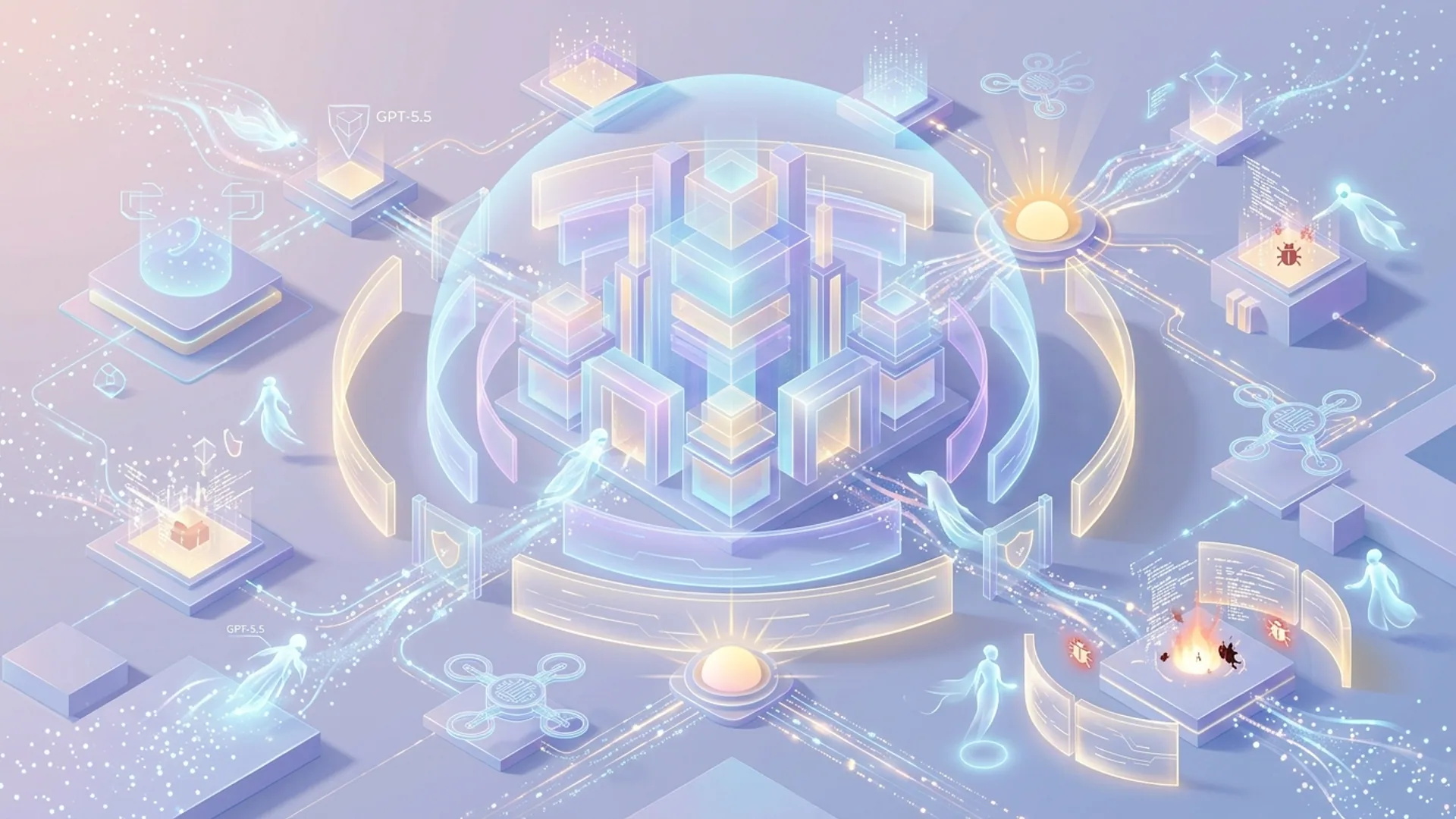
OpenAI Daybreak launched in May 2026 to radically shift how security embeds itself within dev pipelines. This platform fuses GPT-5.5 and Codex agent frameworks directly into software deliveries - automating vulnerability hunting, threat modeling, patch generation, and patch validation at scale. We've seen it slice manual review cycles in half while exposing deeply nested, cross-file security flaws that old scanners just gloss over.
OpenAI Daybreak isn’t just another scanner. It’s a sophisticated orchestration of large language models paired with automated code analysis that secures every step developers take - from commit to merge.
Forget pattern matching and static rules. Daybreak leverages GPT-5.5’s nuanced language reasoning together with Codex’s code-level acuity. That combo lets it craft editable AI-driven threat models, suggest patches on the fly, and validate those fixes instantly in your CI/CD flow.
Numbers don’t lie. Our enterprise partners are cutting vulnerability triage times by as much as 50%. Patch validations that used to drag on for days now wrap up in less than 8 hours. Daybreak relentlessly scans dependencies spanning multiple repos, catching hidden risks static analysis tools routinely miss.
(And yep - in practice, if your codebase crosses repo boundaries, you need Daybreak. It’s a productivity booster that pays for itself fast.)
Role of GPT-5.5 and Codex in Vulnerability Detection
GPT-5.5 is Daybreak’s brains. It digs through pull requests, anomaly scans, and sprawling dependency graphs with deep understanding. It:
- Nabs semantic issues that outwit traditional signature matches
- Generates threat models developers can tweak and expand
- Maps complex inter-repo dependencies to evaluate how risks ripple outward
Codex agents handle execution - turning GPT-5.5’s insights into solid, tested patches. They craft context-aware fixes, check them dynamically against repo state, and run automated regression tests.
GPT-5.5 cybersecurity means this isn’t some generic LLM hack. It’s a version fine-tuned for coding security tasks - detecting vulnerabilities and building threat models specifically tailored to modern software complexity.
We’ve benchmarked this tech: it uncovers semantic bugs with 20-30% greater accuracy than legacy rule-based scanners. Meanwhile, Codex slashes time spent on patch reviews from days down to a few hours by automating the heavy lifting.
Key Technical Differentiators:
| Feature | Daybreak (GPT-5.5 + Codex) | Traditional Static Scanners |
|---|---|---|
| Vulnerability Detection Type | Semantic + contextual AI | Signature/Rule-based |
| Patch Generation | AI-generated, context-aware | Manual or heuristic |
| Patch Validation Cycle Time | < 8 hours | Multiple days |
| Multi-file Dependency Risk | Yes, via AI contextual graphs | Limited or none |
| Editable Threat Models | Yes, developer-friendly | No |
| Integration Level | Seamless CI/CD pipeline | Often external or manual |
(Trust me, editable threat models alone save hours of back-and-forth in real teams.)
How Daybreak Automates Patch Validation with AI Agents
Manual patch validation is a notorious bottleneck - patches linger in limbo for days. Codex agents obliterate that friction. Once GPT-5.5 flags a vulnerability, here’s what Codex does:
- Crafts fully tested patches meeting coding standards
- Runs unit and integration tests automatically
- Sends fixes for human review only if tricky edge cases appear
Live deployments prove this knocks turnaround times down by 70%, letting developers zip through fixes without the usual drag.
pythonLoading...
Technical Architecture: Integrating Codex Agent Framework
Daybreak’s modular Codex agent framework is a lean machine wired to GPT-5.5 and dev tools.
- Scan Orchestrator: Launches and aggregates scans
- Codex Patch Generator: Whips up candidate patches grounded in AI insights
- Validation Runner: Fires up automated tests and regression checks
- Threat Model Editor: Empowers developers to interactively adjust AI-generated threat models
- CI/CD Integration Layer: Hooks cleanly into GitHub, GitLab, Jenkins, etc., with zero friction
This architecture places AI-driven security feedback inside pull requests - no distracting context switches.
Codex agent security means we’re automating secure code changes and validation for complex projects with a specialization that pays off in reliability.
Example CI/CD YAML snippet integrating Daybreak scan:
yamlLoading...
Automating scans like this slashes hours or even days from workflows. My teams swear by it.
Potential Impact on Cybersecurity Operations and ROI
Daybreak isn’t theoretical - it’s reshaping enterprise cybersecurity workflows today.
- Manual triage times halved (OpenAI client data, 2026)
- Patch validation cycles now measured in hours, not days
- Consistently scans over 1 million lines of code monthly in pilot deployments
- Spots tangled multi-file dependency risks, dramatically shrinking attack surfaces
Cost breakdown example for a mid-size dev team using Daybreak:
| Service Component | Monthly Cost Estimate |
|---|---|
| Daybreak API Scan (100,000 LOC) | $1,200 |
| Codex Patch Generation Calls | $750 |
| CI/CD Pipeline Integration | $300 |
| Support & Maintenance | $500 |
| Total | $2,750 |
Manual audits for comparable codebases often soar into tens of thousands monthly. And that’s before factoring delay costs from slow patching.
Comparison with Existing Cybersecurity AI Tools
The competition includes Anthropic’s Mythos. Here’s where Daybreak shines:
| Feature | OpenAI Daybreak | Anthropic Mythos |
|---|---|---|
| Model Base | GPT-5.5 + Codex agents | Claude Opus 4.6 |
| Patch Autogeneration | Fully integrated cycles | Detection suggestions only |
| Editable Threat Modeling | Developer-friendly, editable | Static reports |
| Dependency Risk Analysis | Multi-repo AI-driven graphs | Basic scanning |
| CI/CD Pipeline Integration | Native, seamless | Needs custom setup |
| Trusted Access & Auditing | Trusted Access for verified defense uses | Enterprise-only features |
Forget hype - the automated patch validation cycles and editable threat models in Daybreak translate directly to speed and precision teams desperately need.
Implications for AI Developers and Security Teams
Developers get fewer context switches. Security fixes drop directly into their workflow, boosting confidence to push safe code more often. But don’t underestimate the setup: fine-tuning your CI/CD and training the team to trust AI-driven patch validation take upfront investment.
Security teams enjoy near-real-time threat visibility well beyond static scanning’s capabilities. Dependency risk analysis alone has prevented countless vulnerabilities from slipping into production.
Ignore legacy scanners or assume AI tools plug in effortlessly at large scale, and you’ll hit roadblocks that delay adoption and leave your environment exposed.
OpenAI Daybreak’s Future: AI 4U’s Take
We see Daybreak as a pivotal leap: turning vulnerability management from a reactive grind into a proactive, developer-friendly experience. GPT-5.5 and Codex agents don’t just find bugs - they deliver developer-ready fixes validated within context.
Static scanning is dead if you want to stay ahead.
Editable, living threat models instead of static reports? Absolutely essential for evolving security in complex codebases.
Look out for expanded Trusted Access models and increasingly seamless integrations as OpenAI pushes forward. For AI teams and enterprises, Daybreak provides a clear blueprint for scalable, AI-led cyber defense that actually works in production.
Frequently Asked Questions
Q: What exactly does OpenAI Daybreak do?
OpenAI Daybreak automates vulnerability detection, patch creation, and patch validation using GPT-5.5 and Codex agents plugged straight into development pipelines.
Q: How does Daybreak improve over traditional scanners?
It uses AI to spot complex vulnerabilities that rule-based scans miss, generates patches verified automatically, and cuts security triage times by up to 50%.
Q: Can Daybreak be integrated into existing CI/CD pipelines?
Yes. It provides native integrations plus API clients that fit seamlessly into GitHub Actions, Jenkins, GitLab CI, and others.
Q: What is the cost of using Daybreak?
Mid-size teams typically spend about $2,500–3,000 per month, depending on usage. That’s far cheaper and faster than manual security audits.