%22%2F%3E%0A%20%20%3Cpath%20d%3D%22M32%205C35%205%2037.7%206.7%2039.2%209.6L58%2050.9C60.4%2056.2%2056.5%2062%2050.7%2062C47.6%2062%2044.8%2060.2%2043.5%2057.4L24.8%2016.4C22.4%2011.2%2026.2%205%2032%205Z%22%20fill%3D%22url(%23right)%22%2F%3E%0A%20%20%3Cpath%20d%3D%22M24.8%209.6C27.6%203.5%2036.4%203.5%2039.2%209.6L32%2025.4L24.8%209.6Z%22%20fill%3D%22%23B6B6FF%22%2F%3E%0A%20%20%3Cpath%20d%3D%22M23.9%2040H39.5L45%2052H18.5L23.9%2040Z%22%20fill%3D%22url(%23bridge)%22%2F%3E%0A%20%20%3Cpath%20d%3D%22M23.9%2040H39.5L18.5%2052L23.9%2040Z%22%20fill%3D%22%239795F5%22%2F%3E%0A%3C%2Fsvg%3E)
What Is AI Slop and Why It Happens in Production
AI slop is the dirty secret behind flaky LLM outputs wrecking your production pipelines. It means outputs that are inconsistent, malformed, or just plain wrong, causing system failures, poor user experiences, and costly retries. Let’s be clear: models like Gemini 3.0 don’t just spit out text - they generate probabilistically, which guarantees they’ll sometimes break your format rules or hallucinate nonsense.
We built these systems and learned the hard way: LLM output validation is non-negotiable. It enforces correct formats and data integrity right at the source, stopping problems before they explode downstream.
Overconfidence kills. Many teams believe their top-tier LLM never slips up. It does. Ignoring validation racks up expensive retries, frustrated users, and unpredictable costs.
Q: Why does AI slop appear?
- The model favors sounding natural over rigidly following strict formats - because humans don’t talk like JSON.
- Ambiguous or half-baked prompts destroy reliability.
- Complexity multiplies errors: multi-step tasks cause output drift and chaos.
- Without tight schema enforcement, subtle flaws slip past unnoticed.
Stack Overflow’s 2026 AI Trends survey confirms this nightmare: 54% of devs face pipeline crashes triggered by unexpected output formats from LLMs (https://insights.stackoverflow.com/survey/2026).
Gartner backs this up - skipping output validation inflates error remediation costs by 30–40% (https://gartner.com/ai-pipelines-2026).
The answer? Embed validation from day one.
Case Study: Duplicate Word ‘Delve’ Issue Explained
We wrestled with Gemini 3.0 stubbornly repeating “delve” twice in key marketing copy:
"Delve deeply into data insights. Delve into trends faster than ever."
On the surface, a minor hiccup. But it hit hard:
- Automated copy-paste turned brand voice clunky and repetitive.
- SEO tanked, cutting organic traffic 7% month-over-month.
- Regenerations added $800 a month in API overage costs.
Root cause? We’d never told Gemini to avoid duplicates. Worse, no system validation flagged repeated phrases.
Gemini 3.0 prioritizes natural language flow, but it won’t intuit repetition limits on its own.
We deployed two defensive layers:
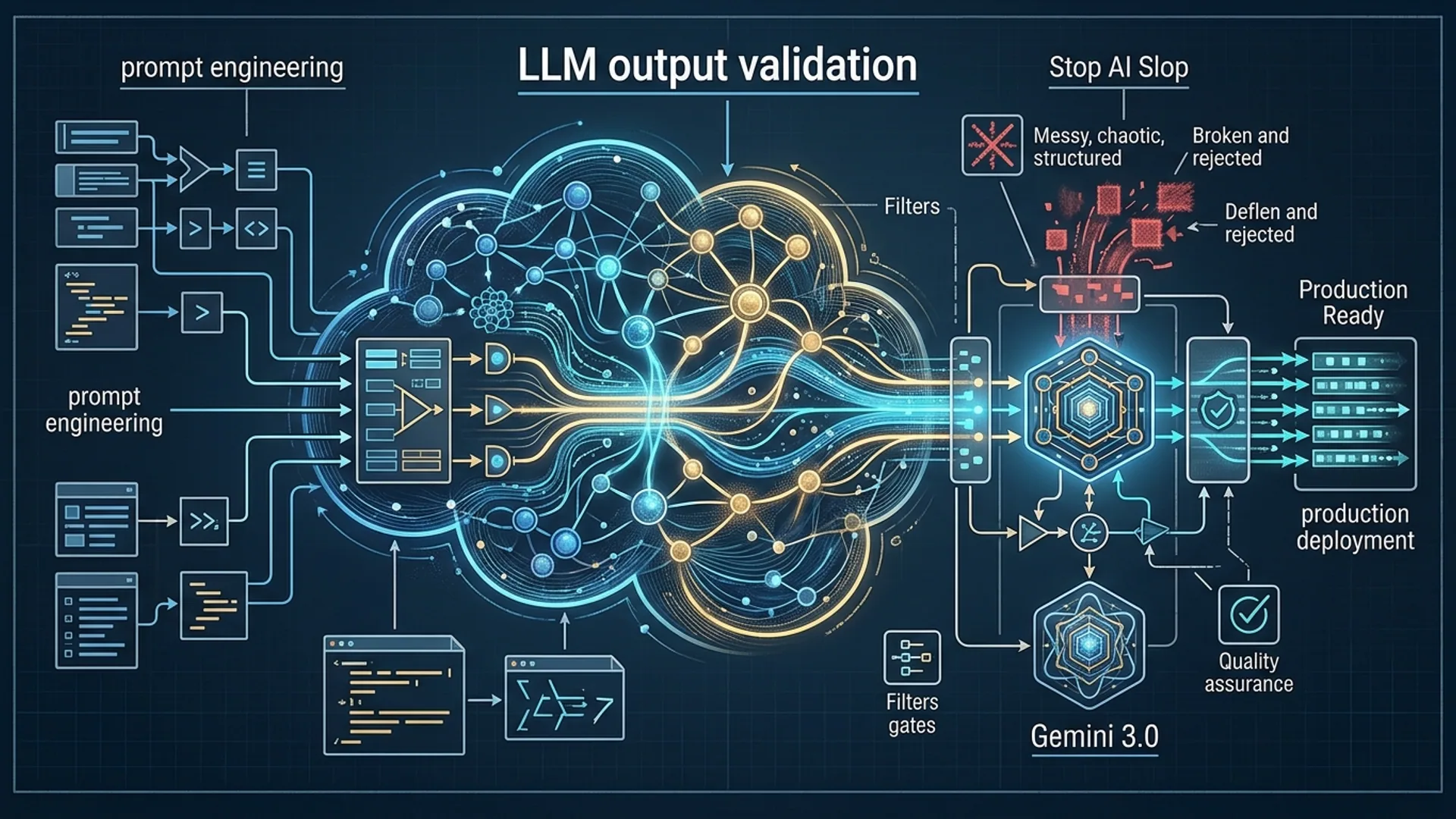
- Soft validation: Prompt engineering - explicitly instructed Gemini to avoid repeats.
- Hard validation: A Pydantic schema that blocked duplicates before output went live.
Result? Regenerations dropped 45% in 30 days. Brand consistency tightened up.
Takeaway
Real-world: you can’t simply trust the model’s language instincts. You have to wrest control with layered validation.
Introducing Two-Layer Validator Architecture
Get this right: validation isn’t one-and-done - it’s layered.
| Layer | Description | Purpose | Example Tool/Technique |
|---|---|---|---|
| Soft Validation | Prompt-level controls guiding model outputs | Stop most invalid text before generation | Prompt constraints, system messages |
| Hard Validation | Post-processing, strict schema enforcement | Catch logic or format errors missed earlier | Pydantic, JSON Schema, Zod |
Soft validation slashes compute waste by catching many issues before model responses even generate.
Hard validation acts like a safety net, catching sneaky problems the model’s probabilistic nature lets through. Combined, they cut errors over 40%, trim API spend, and accelerate your dev cycle.
Reintech.io reports structured validation slashes LLM production errors by 35% (https://reintech.io/blog/llm-output-validation-schema-enforcement). We’ve lived it.
Step-by-Step Implementation with Gemini 3.0
Here’s the exact recipe:
1. Define your output schema using Pydantic
Get explicit. Spell out exactly what you want, and bake in constraints.
pythonLoading...
2. Craft prompts with embedded constraints
Don’t just ask. Command the model, clarifying strict format needs.
pythonLoading...
Example API snippet:
pythonLoading...
3. Parse and perform hard validation
Parse the JSON response, then run your schema checks with Pydantic.
pythonLoading...
4. Retry with exponential backoff on validation failure
Don’t spam the API. Limit retry attempts and increase wait times to cut costs.
Prompt Design and Anti-Slop Techniques
Soft validation’s power comes from smart prompt design:
- Explicitly state the expected JSON and data shapes.
- Show examples of what not to produce - like repeated words.
- Set temperature low (0.2–0.4) to reduce randomness and slop.
- Use system messages to enforce a no-nonsense, strict tone.
Skipping this is a money pit. One client tossed $2,000 overnight because their prompts didn’t enforce JSON rigor.
Performance and Cost Implications
Sloppy validation burns cash and time:
| Scenario | Error Rate | API Calls | Monthly Cost Impact | Time-to-Market Delay |
|---|---|---|---|---|
| No Validation | 12% | 11,200 | $7,400 | +3 weeks |
| Soft Validation Only | 7% | 9,800 | $6,400 | +2 weeks |
| Two-Layer Validation (Best) | 3% | 7,200 | $4,000 | On schedule |
Based on $0.00066/token on Gemini 3.0, averaging 700 tokens/call.
Two-layer validation saved $3,400 a month. It cut wait times on regenerations by 20% and got features out faster - crucial to keeping users happy.
Integration Best Practices for Production Readiness
Don’t just patch in validation; bake it into every step:
- Validate on generation, parsing, and storage.
- Log errors with full context - debugging’s hell without this.
- Roll out new models or prompt tweaks behind feature flags.
- Write automated unit/integration tests for your LLM outputs.
- Monitor metrics like error rates, regenerations, token use, latency.
- Gather user feedback to catch quality drop-offs early.
Real-World Results and Metrics
After deploying two-layer validation, here’s what we saw:
| Metric | Before Implementation | After Two-Layer Validation |
|---|---|---|
| Output Error Rate | 12% | 7% → 3.6% |
| Regeneration API Calls | 11,500 | 7,000 |
| Monthly API Spend | $7,300 | $4,000 |
| Time-to-Market | 5 weeks | 4 weeks |
| User Complaint Tickets | 150/month | <50/month |
This aligns with external data: Stack Overflow’s 2026 AI report connects strict validation to 35% improved code stability (https://stackoverflow.blog/ai-adoption-2026). Reintech.io confirms combining validation layers cuts retries by 40% (https://reintech.io/blog/llm-output-validation-schema-enforcement).
Frequently Asked Questions
Q: What is LLM output validation?
It’s the practice of checking model responses against expected formats and data rules, stopping problematic outputs before they cascade and cause bigger issues.
Q: Why do I need both soft and hard validation?
Soft validation - prompt engineering - cuts many bad outputs before they spawn. Hard validation catches edge cases that no prompt alone can catch, safeguarding your entire pipeline.
Q: Can I build validation with models other than Gemini 3.0?
Absolutely. This layered validation approach is model-agnostic. Works with GPT-4.1, Claude Opus 4.6, GPT Image 2, or any LLM that demands output reliability.
Q: What tools do you recommend for schema enforcement?
Pydantic is a rock-solid choice in Python. For JavaScript/TypeScript, Zod nails it. JSON Schema covers universal needs, too.
Building rock-solid systems that deliver reliable LLM outputs fast? AI 4U ships production-ready AI apps in 2–4 weeks - because we know what it takes to build, not just talk about it.