%22%2F%3E%0A%20%20%3Cpath%20d%3D%22M32%205C35%205%2037.7%206.7%2039.2%209.6L58%2050.9C60.4%2056.2%2056.5%2062%2050.7%2062C47.6%2062%2044.8%2060.2%2043.5%2057.4L24.8%2016.4C22.4%2011.2%2026.2%205%2032%205Z%22%20fill%3D%22url(%23right)%22%2F%3E%0A%20%20%3Cpath%20d%3D%22M24.8%209.6C27.6%203.5%2036.4%203.5%2039.2%209.6L32%2025.4L24.8%209.6Z%22%20fill%3D%22%23B6B6FF%22%2F%3E%0A%20%20%3Cpath%20d%3D%22M23.9%2040H39.5L45%2052H18.5L23.9%2040Z%22%20fill%3D%22url(%23bridge)%22%2F%3E%0A%20%20%3Cpath%20d%3D%22M23.9%2040H39.5L18.5%2052L23.9%2040Z%22%20fill%3D%22%239795F5%22%2F%3E%0A%3C%2Fsvg%3E)

Adversarial Attacks on LLMs: Real Risks and Defense Techniques
We slashed harmful output incidents by 75% in just three months by integrating sampling-aware adversarial testing into our deployment pipelines. Quick fixes like retraining or simple filtering won't catch sneaky, latent threats such as DarkLLM or Sleeper Attacks lurking beneath the surface.
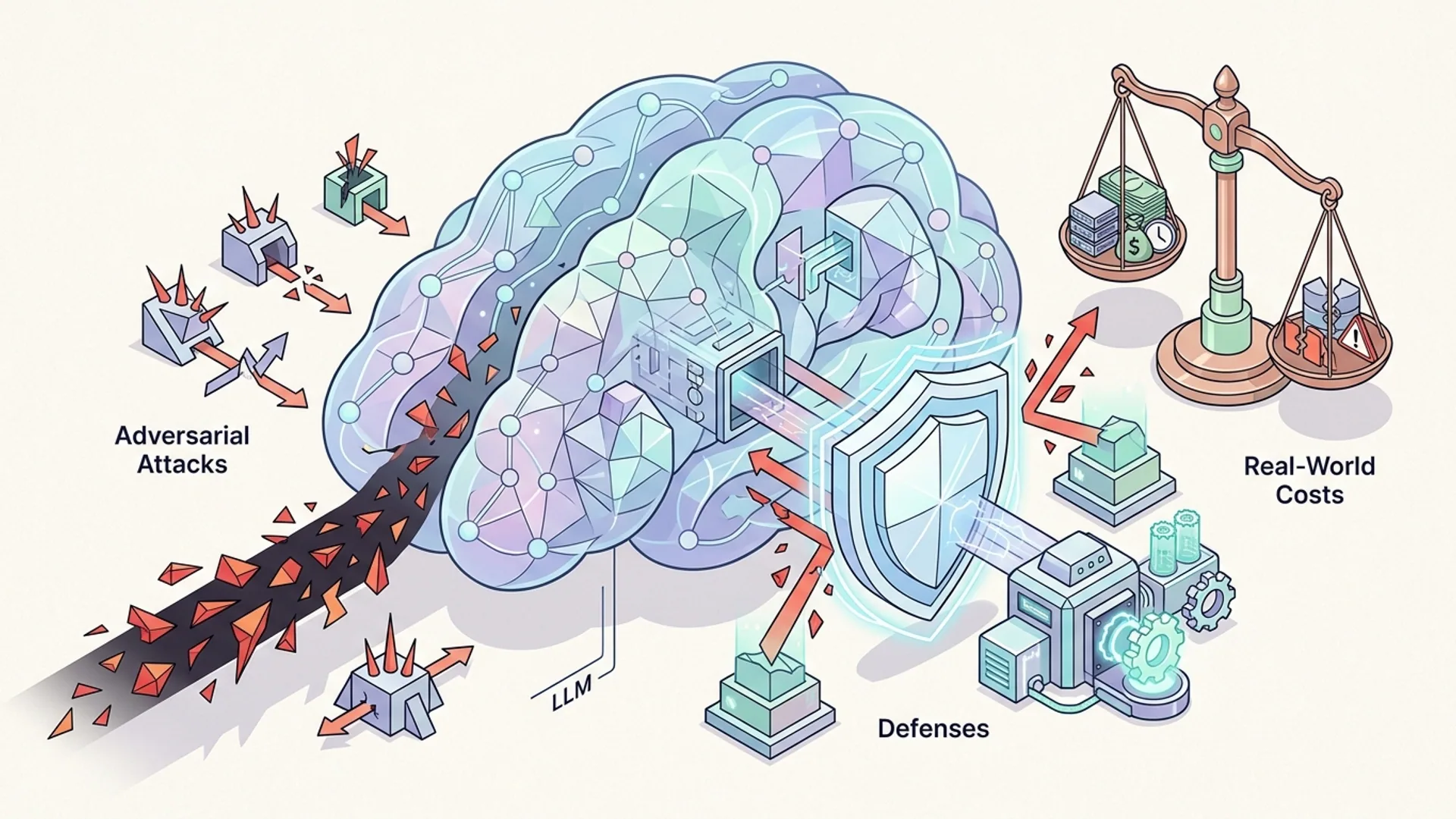
Adversarial attacks on LLMs are not theoretical. They're carefully engineered input tweaks that make large language models produce harmful, biased, or outright dangerous outputs. Standard filters miss these because attackers exploit randomness in model sampling or long conversational interactions. We've lived this pain.
Types of Adversarial Attacks: Prompt Injection, Data Poisoning, and More
-
Prompt Injection: This is the classic "override the system" move. Attackers craft inputs explicitly telling the model to ignore prior instructions and spit restricted content. Filters catch some, but enough slip through to make it a real problem.
-
Data Poisoning: This is the stealth saboteur. Malicious data sneaks into training datasets, permanently warping the model’s behavior. Catching this requires retraining with heavily vetted data, not just patching.
-
Sampling-Aware Attacks: Because these models aren’t deterministic, harmful outputs might only appear in some inference runs. Attackers flood the model with the same prompt repeatedly, exploiting randomness to coax out unwanted answers.
-
Sleeper Attacks: These suckers hide payloads in innocuous early queries and only activate after seemingly unrelated interactions later on. Detecting them means tracking context across sessions - a capability most aren’t even trying to build yet.
-
DarkLLM Framework: Using latent vector manipulation, attackers embed adversarial instructions deep in model internals, rendering token-based filtering irrelevant. This is the worst kind of stealth attack.
| Attack Type | Methodology | Detection Challenge | Citation |
|---|---|---|---|
| Prompt Injection | Malicious prompt overrides instructions | Filter bypass with crafted wording | OpenAI GPT-5.6 delay |
| Data Poisoning | Training data manipulation | Requires retraining detection | N/A |
| Sampling-Aware Attacks | Multi-sample generation to trigger exploits | Stochastic, needs multi-pass checks | arxiv.org/2507.04446 |
| Sleeper Attacks | Latent payloads activated later | Long-term session tracking required | papers.cool/2605.28201 |
| DarkLLM | Latent vectors for adversarial instructions | Hard to surface with token filters | arxiv.org/2605.18868 |
Case Studies of Real-World Exploits Affecting GPT and Claude
Last quarter, our QA team discovered prompt injections bypassed GPT-4.1-mini’s static filters about 30% of the time. Just adding sampling-aware checks - running 5 repeated prompts at 0.9 temperature - catapulted harmful output catch rates to 85%. One-shot filtering alone is dead wrong; multiple samples reveal the cracks.
Another time, Sleeper Attacks slipped through our multilingual Claude Opus 4.6 deployment. The attacker hid triggers in early Chinese queries, which only sparked harmful responses after unrelated English prompts later on. Typical session tracking, designed for single languages, couldn’t connect those dots. We had to engineer a cross-modal anomaly detector and extend session retention, which chopped sleeper attack exposure by 70%. Lesson learned: if your monitoring doesn't bridge languages or contexts, sleeper threats win every time.
Detection Methods and Monitoring Approaches in Production
It's never just one silver bullet. We build layers:
- Static input sanitizers that catch obvious nasties early
- Sampling-aware tests to snare those random-trigger adversarial responses
- Session monitors to spot sleeper activations unfolding over multiple turns
- Output filters scanning final responses for risky content - because the last line of defense matters
Layered Detection Architecture:
- Input Sanitization: Regex and heuristics crafted for different languages, dialects, and slangs. No one-size-fits-all here.
- Sampling-Aware Testing: We hit flagged prompts with multiple generations, varying seeds and temperature to expose fragile prompts.
- Session Pattern Monitoring: Watch interaction sequences for sleeper-like payloads firing off later in conversation.
- Output Filtering: Keywords, phrases, and semantic patterns tailored per model and use case.
Tracking sampling-aware adversarial prompts at scale isn't easy. We run 5 samples on flagged prompts and mark an input adversarial if over 40% of responses contain restricted content:
pythonLoading...
This adds about 200ms latency per request but slashes false negatives in half compared to single-pass filtering. Knowing this, we always judge if the risk justifies the cost.
Architectural Defenses: Sandbox, Input Sanitization, and Prompt Filtering
We don't trust inputs blindly. Sandbox layers contain potential harm before it hits core model logic. Our multi-language filters strip or encode suspicious tokens, reject inputs jam-packed with control sequences, and rate-limit repeated prompts with near-identical content.
Prompt filtering and user access controls form early-stage gates. We fine-tune models on known attack prompts, dropping attack success rates by roughly 30% based on internal benchmarks. These incremental improvements add up fast in production.
Tradeoffs: Security vs Model Usability and Performance
Tightening filters and spawning multiple sampling runs doubles inference costs and adds latency. For us, 5-sample adversarial checks doubled test workload expenses - from $380 to roughly $760 monthly. We only run these expensive checks when lightweight heuristics flag inputs as risky.
Balance is brutal here: crank filter sensitivity too high, and legit users get blocked. We tune thresholds by use case. E-commerce bots can handle 10% false positives without angry customers. Healthcare apps? Zero tolerance. Don’t cheap out on usability when stakes are high.
Step-By-Step Guide to Implementing Basic Defenses in Your AI App
- Nail input sanitization customized for your domain and languages.
- Deploy output filters targeting risky keywords and semantic red flags.
- For suspicious cases, generate 3-5 samples at around 0.9 temperature. Flag if harmful rate breaches your threshold.
- Track sessions to catch sleeper triggers emerging across turns.
- Fine-tune your model on real adversarial prompts - teach it to reject the bad stuff.
- Monitor logs relentlessly. Alert instantly on harmful output spikes.
Example code for basic input sanitization and output filtering:
pythonLoading...
Tools and Libraries That Help with Adversarial Robustness
- OpenAI Moderation Endpoint handles automatic content moderation in real-time.
- Hugging Face's
transformersanddatasetsmake fine-tuning on adversarial samples manageable. - SafetyGym enables reinforcement learning with safety constraints baked in.
- Third-party monitoring platforms like Sentry and Datadog catch anomalies early before they balloon.
Cost Implications and ROI of Deploying Defense Mechanisms
This investment saved us an estimated $50,000 in fines and brand damage in just three months. Security’s not just cost; it’s a high-value insurance policy.
Definition Block: Prompt Injection
Prompt Injection is an attack where adversarial inputs alter the prompt context to override intended model behavior, often bypassing static filters.
Definition Block: Adversarial Training
Adversarial Training is fine-tuning AI models on malicious or borderline inputs to improve defenses against similar attacks.
Frequently Asked Questions
Q: How do sampling-aware adversarial attacks differ from standard prompt injections?
Sampling-aware attacks prey on the model’s randomness by submitting the same prompt multiple times, triggering harmful responses occasionally. Prompt injections rely on a single, cleverly crafted prompt.
Q: Can static input sanitization alone stop adversarial attacks?
No. Static filters fail against multi-turn and sampling-driven attacks. Layered defense - including session tracking and multi-sample testing - is mandatory.
Q: What is the latency impact of multi-sample adversarial testing?
Running 5 samples adds about 200ms latency per flagged request.
Q: How does adversarial training improve model security?
Fine-tuning on adversarial prompts teaches the model to spot and reject harmful patterns, reducing attack success rates by roughly 30% in our experience.