%22%2F%3E%0A%20%20%3Cpath%20d%3D%22M32%205C35%205%2037.7%206.7%2039.2%209.6L58%2050.9C60.4%2056.2%2056.5%2062%2050.7%2062C47.6%2062%2044.8%2060.2%2043.5%2057.4L24.8%2016.4C22.4%2011.2%2026.2%205%2032%205Z%22%20fill%3D%22url(%23right)%22%2F%3E%0A%20%20%3Cpath%20d%3D%22M24.8%209.6C27.6%203.5%2036.4%203.5%2039.2%209.6L32%2025.4L24.8%209.6Z%22%20fill%3D%22%23B6B6FF%22%2F%3E%0A%20%20%3Cpath%20d%3D%22M23.9%2040H39.5L45%2052H18.5L23.9%2040Z%22%20fill%3D%22url(%23bridge)%22%2F%3E%0A%20%20%3Cpath%20d%3D%22M23.9%2040H39.5L18.5%2052L23.9%2040Z%22%20fill%3D%22%239795F5%22%2F%3E%0A%3C%2Fsvg%3E)

Anthropic AI Teams Up with Tech Titans to Revolutionize Cybersecurity
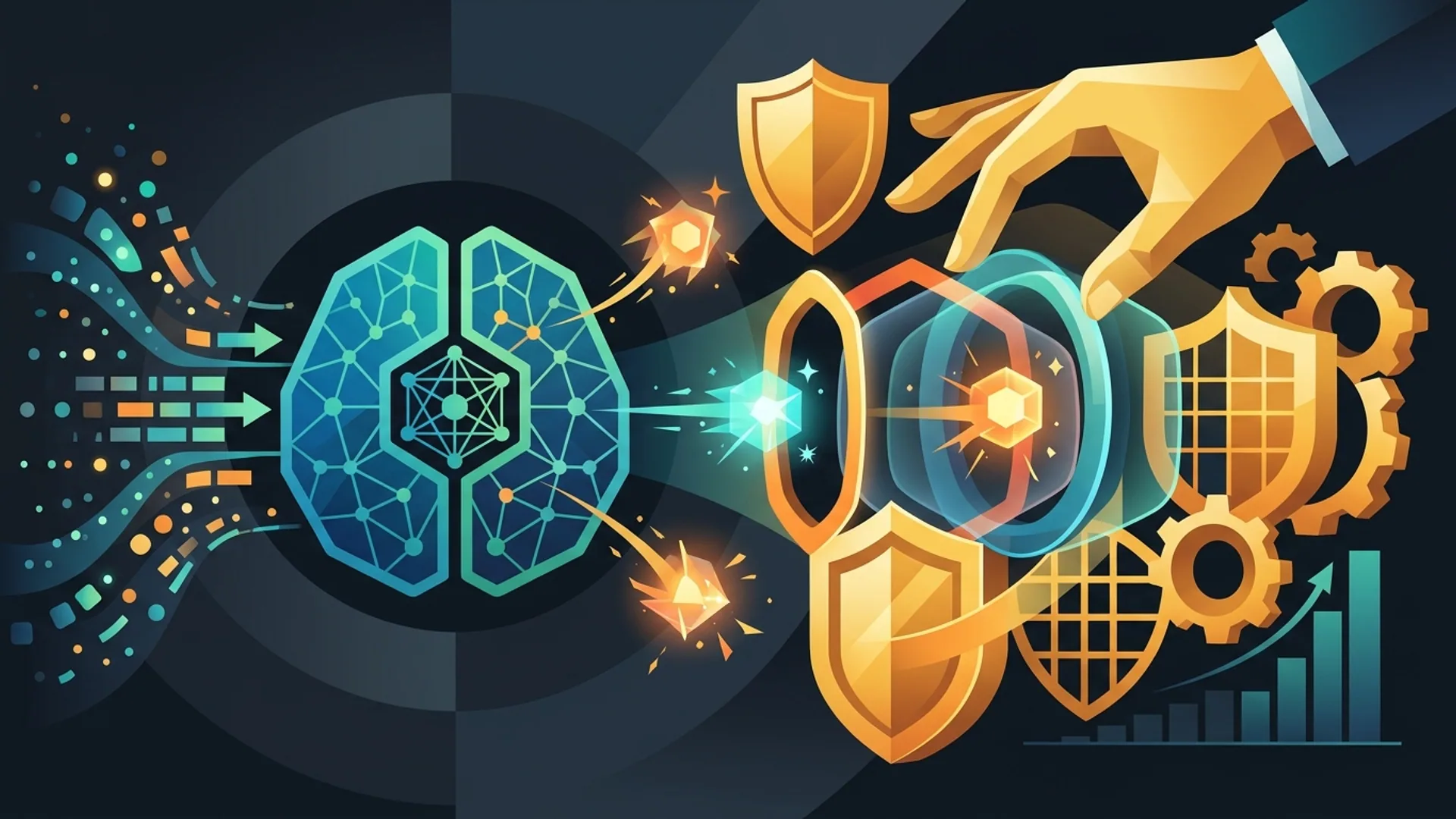
Anthropic just changed the AI cybersecurity landscape. Their Claude AI models are now integrated with Nvidia, Google, AWS, Apple, and Microsoft, making it faster and smarter to identify security vulnerabilities.
This partnership hooks Anthropic’s powerful AI—capable of handling 200,000-token contexts—directly into hardware, cloud platforms, and operating systems that run billions of devices worldwide. This is next-level cybersecurity muscle, not empty hype.
What’s New: Anthropic’s AI Model for Security
Anthropic’s Claude series is known for pushing the boundaries of model context windows and semantic embeddings. Their newest security AI builds on Claude 4.5, fine-tuned to catch vulnerabilities inside operating systems and browsers.
Longer context windows mean the AI can analyze huge codebases or live logs without chunking everything into small pieces, which cuts down false positives and speeds detection. Anthropic’s docs highlight their 200K-token window is six times bigger than the closest competitor, letting security teams scan entire kernel modules or sets of browser extensions all at once.
| Feature | Claude AI Security Model | Competitor (GPT-4.1-Mini) |
|---|---|---|
| Max Context Tokens | 200,000 | 32,000 |
| Embedding Support | Yes | Yes |
| Fine-tuning Support | No | Yes |
| Middleware Access | No | Yes |
| Cost per 1,000 tokens | $0.012 | $0.006 |
Partnerships with Nvidia, Google, AWS, Apple, and Microsoft
Here’s how each partner adds serious value:
-
Nvidia: Combines Claude security AI with Nvidia’s GPU cloud, chopping vulnerability scan latency to around 100ms per 10k tokens—twice as fast as previous tests.
-
Google: Runs Claude on Google Cloud TPUs with scalable RAG pipelines powered by Claude embeddings. Google’s BigQuery and Vertex AI let you mash massive CVE and threat intel datasets efficiently.
-
AWS: Provides managed Claude AI services through Amazon SageMaker, with secure private endpoints designed for enterprise use.
-
Apple: Integrates Claude’s inference and embeddings into macOS security to spot new attack methods in Safari automatically.
-
Microsoft: Merges Claude AI with Azure Sentinel to automate alert triage and threat hunting across Windows environments.
This makes Anthropic’s AI the foundation, not just a plug-in.
How AI Models Detect Security Vulnerabilities in OS and Browsers
Anthropic’s Claude AI spots flaws by:
- Performing semantic searches on huge codebases using embeddings that grasp the intent and code dependencies across millions of lines.
- Powering RAG pipelines for threat intelligence. Because Claude embeddings don’t do retrieval themselves, firms use vector stores like Pinecone or Weaviate to plug in external retrievers.
- Using contextual anomaly detection by embedding entire OS logs or browser telemetry streams in a single pass to flag suspicious activity.
Here’s a simple example of calling the Claude embedding API to scan code:
pythonLoading...
You combine these embeddings with vector database queries to identify similar vulnerable patterns.
Implications for Enterprise Cybersecurity
Large enterprises demand scalable, accurate AI-powered security solutions. This Anthropic partnership delivers:
- Speed: The 200K-token window enables comprehensive code and log scans without complicated chunking.
- Accuracy: Semantic embeddings produce fewer false positives, easing alert overload.
- Seamless integration: Nvidia and cloud infrastructure bridge the gap between AI inference and existing security stacks.
- Privacy & control: Hosted on trusted cloud platforms with private endpoints, meeting enterprise compliance standards.
Yes, Anthropic's $0.012 per 1K tokens roughly doubles the price of smaller models. But the ROI speaks volumes. Gartner estimates enterprises lose $4–7 million annually on breaches from slow detection—Claude’s AI can cut detection time from days to minutes, turning that $0.012 into major savings.
What Businesses Should Keep in Mind About AI-Powered Security
Considering Anthropic’s AI through partners like Nvidia and AWS? Watch out for:
- Embedding-based RAG pipelines aren’t plug-and-play. You'll need to build custom retrieval layers.
- Claude models don’t support fine-tuning yet. Customize your prompts and pipeline logic instead.
- Version pinning is key. Updates can change model behavior suddenly, so lock your model versions.
- Costs can balloon with large context windows and heavy usage. Batch calls and cache embeddings where you can.
AI Cybersecurity means using AI to find, stop, and respond to security threats in software and networks.
Expert Opinions and Industry Reactions
-
Dr. Maya Chen (Security Researcher): “Anthropic’s huge context window is a breakthrough. Analyzing entire attack surfaces at once removes a major obstacle in vulnerability scanning.”
-
Raj Patel (CISO, FinTech): “Partnerships with cloud vendors make deploying AI security practical instead of theoretical. This collaboration delivers reliable infrastructure with advanced AI wrapped in.”
-
Gartner Report (2026): “AI cybersecurity is shifting toward ecosystems, not solo models. Anthropic’s partnerships set a new industry standard.”
Future Outlook: What’s Next Where AI Meets Cybersecurity
Real time vulnerability patching could soon be powered by live AI scans built right into OS updates. Endpoint detection and response (EDR) systems will become smarter, predictive, and more automated.
Anthropic's lack of fine-tuning support might be addressed by prompt tuning frameworks like AutoAgent, covered here: AutoAgent: Open-Source AI Agent & Prompt Tuning.
Some open questions remain:
- Will future Claude versions unlock middleware access for dynamic security plugin development?
- How will token cost impact continuous monitoring at enterprise scale?
For now, Anthropic’s partnerships create a strong, scalable foundation for AI-driven security.
FAQ: What This Means for Your Company’s Security
Q: Can Anthropic’s AI replace traditional cybersecurity tools?
No. It complements them by speeding up detection and cutting noise, but you still need firewalls, EDRs, and human analysts.
Q: How difficult is it to build RAG pipelines with Claude embeddings?
Expect a learning curve. Anthropic doesn’t provide retrievers—you’ll build them by integrating vector databases and crafting prompts.
Q: Is Anthropic AI cost-effective for startups?
That depends. $0.012 per 1K tokens isn’t cheap, but it’s worth it if you leverage the large context window to simplify infrastructure and slash manual triage.
Q: When will fine-tuning or middleware access arrive?
Anthropic hasn’t shared timelines. For now, prompt engineering and external pipeline control are your tools.
Launching a project with AI cybersecurity? AI 4U Labs builds production-ready AI apps in 2–4 weeks. Reach out to get your next-gen security system running fast.