%22%2F%3E%0A%20%20%3Cpath%20d%3D%22M32%205C35%205%2037.7%206.7%2039.2%209.6L58%2050.9C60.4%2056.2%2056.5%2062%2050.7%2062C47.6%2062%2044.8%2060.2%2043.5%2057.4L24.8%2016.4C22.4%2011.2%2026.2%205%2032%205Z%22%20fill%3D%22url(%23right)%22%2F%3E%0A%20%20%3Cpath%20d%3D%22M24.8%209.6C27.6%203.5%2036.4%203.5%2039.2%209.6L32%2025.4L24.8%209.6Z%22%20fill%3D%22%23B6B6FF%22%2F%3E%0A%20%20%3Cpath%20d%3D%22M23.9%2040H39.5L45%2052H18.5L23.9%2040Z%22%20fill%3D%22url(%23bridge)%22%2F%3E%0A%20%20%3Cpath%20d%3D%22M23.9%2040H39.5L18.5%2052L23.9%2040Z%22%20fill%3D%22%239795F5%22%2F%3E%0A%3C%2Fsvg%3E)
Ship an iOS product
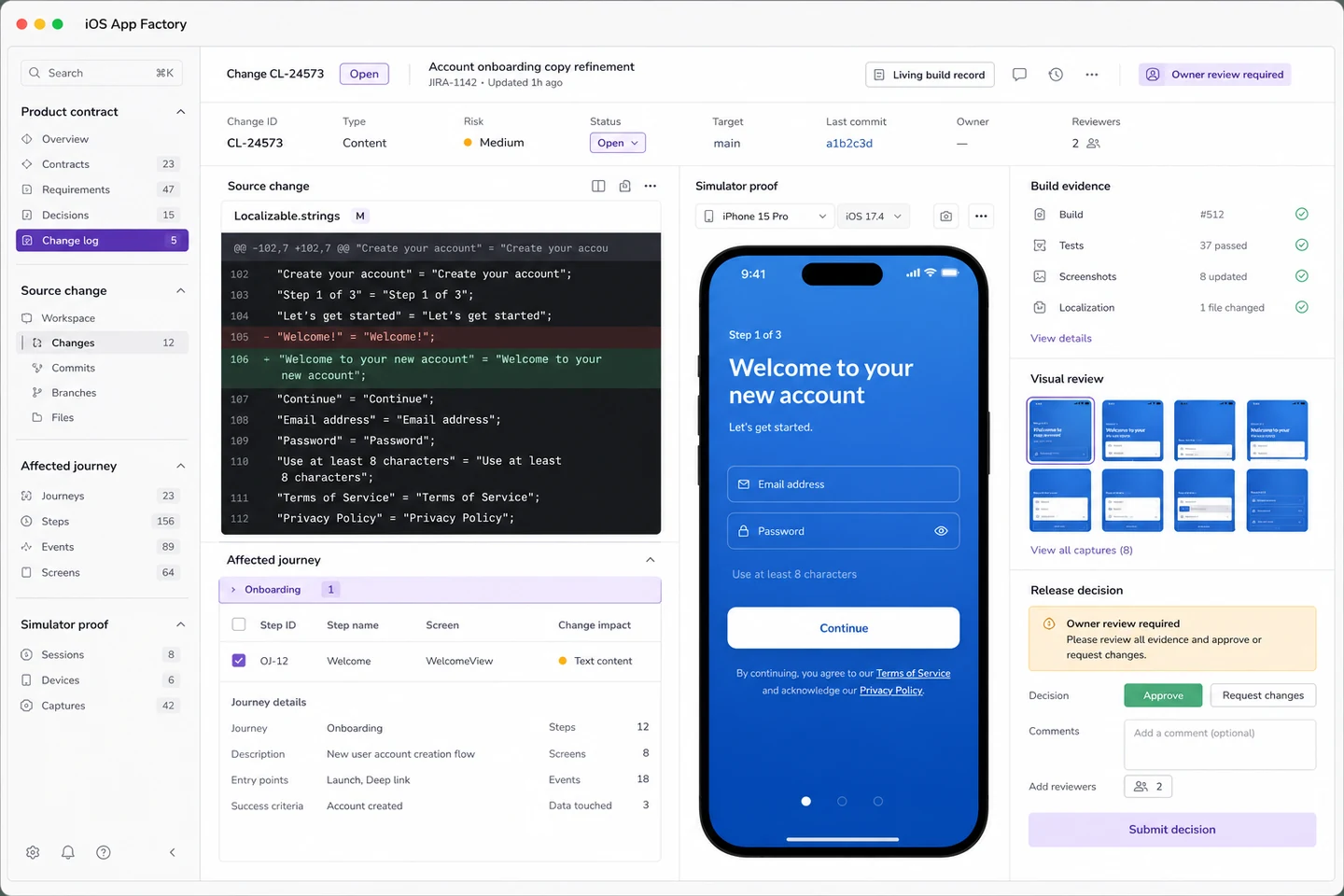
Keep product intent, source changes, simulator evidence, launch creative, and release judgment attached.
Treat generated source as one part of the build. Preserve the product contract, prove the real user journey, review the visual experience, and keep the final release decision with a responsible owner.
The adaptation is scoped around the team's product contracts, native stack, evidence rules, and release process.
Follow the decision.
Keep the proof attached.
The sequence makes the input, each supporting system, the human decision, and the accountable output legible as one path.
- 00Representative inputBegin with what is known
A product contract naming the user, painful status quo, signature moment, scope, integrations, visual direction, and acceptance evidence.
- 01Product creation system
iOS App Factory
AI 4URole in this missionKeep the product contract, source, runtime evidence, and iteration history in one build record.
Internal proofRequest or discuss- Evidence
- Source and retained local QA evidence
- Checked
- Aug 16, 2026
- Limit
- This is not fresh proof that every generated app, external service, release asset, or store submission is production-ready.
Discuss adapting this systemThe internal factory remains private. AI 4U can adapt its product contracts, build gates, simulator evidence, and review loops for another app program.
- 02Creative production workflow
Screenshot Studio
AI 4URole in this missionTurn approved product truth into a reviewed launch story and export set.
Internal proofRequest or discuss- Evidence
- Source and retained local QA evidence
- Checked
- Aug 16, 2026
- Limit
- This is not fresh proof of a public purchase, store approval, conversion improvement, or reliable output for every app category.
Discuss adapting this systemThe production workflow remains private. AI 4U can adapt its story roles, design controls, review gates, and export needs for another creative program.
- 03AI 4U automation
Release Readiness Review
AI 4URole in this missionInspect a release-gate blueprint that separates source review from visual and functional proof.
Blueprint onlyInspect blueprint- Evidence
- Canonical automation blueprint
- Checked
- Aug 20, 2026
- Limit
- The checks are not yet a single proven release gate across every AI 4U product, and visual or functional QA cannot be inferred from source scores.
Inspect systemInspect the defined workflow and its unproven boundary.
- 04Independent agent
Cursor Agent
CursorRole in this missionEvaluate an independent codebase agent through its dated official-source record.
Official sources onlyInspect source record- Evidence
- Cursor features page and Agent documentation
- Checked
- Aug 20, 2026
- Limit
- This record summarizes official product material only. It is not an AI 4U test, ranking, endorsement, or recommendation for the visitor's use case.
Inspect source recordOpen AI 4U's dated, source-led record first. Product access stays with the independent provider.
- 05Required approvalJudgment stays visible
A product owner decides the promise, experience, scope, risk boundary, required evidence, creative claims, and release state.
- 06Expected outputEnd with an accountable record
Native source, build and simulator receipts, visual review, launch-story assets, remaining risks, and a human release decision.
What this collection does not prove
The iOS App Factory and Screenshot Studio remain private internal systems that can be adapted, not public self-serve products.
Source generation, build success, simulator behavior, live services, visual quality, store assets, and submission readiness are separate proof gates.
The mission, before the software.
- Who is this for?
- Product studios and internal teams that need repeatable native app creation without letting generation outrun taste, runtime proof, or release control.
- What job does it solve?
- Turn one product promise into a native app and an inspectable release record without confusing a successful build with a finished product.
- Representative input
- A product contract naming the user, painful status quo, signature moment, scope, integrations, visual direction, and acceptance evidence.
- Expected output
- Native source, build and simulator receipts, visual review, launch-story assets, remaining risks, and a human release decision.
- Required approval
- A product owner decides the promise, experience, scope, risk boundary, required evidence, creative claims, and release state.
Keep product intent, source changes, simulator evidence, launch creative, and release judgment attached.
The adaptation is scoped around the team's product contracts, native stack, evidence rules, and release process.